


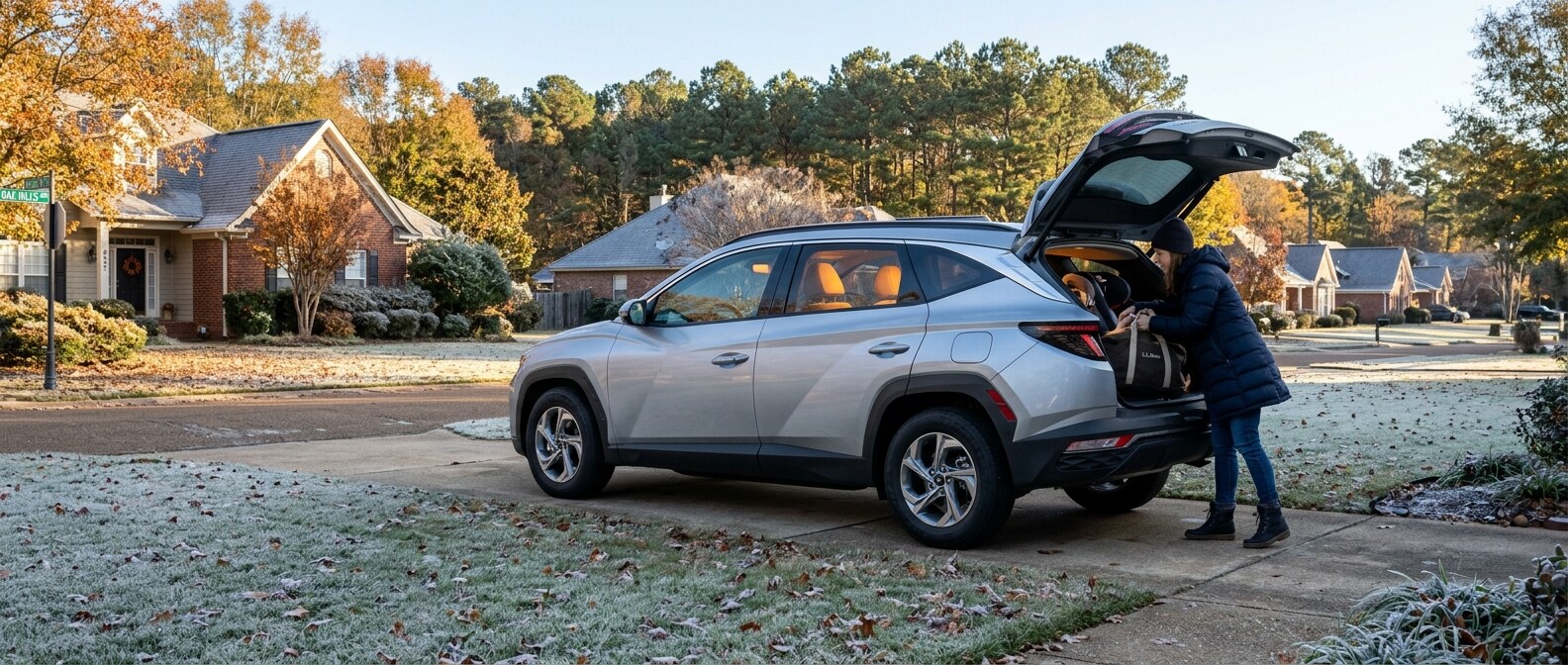
The holiday run from Ridgeland to wherever your family lives usually lands somewhere between a relaxed hour and a genuine all-day drive. Either way, a hybrid wants a slightly different pre-trip look than a conventional gas car. The difference isn't dramatic, but it's real.
Get these eight items sorted before you leave the driveway, and you can stop thinking about the vehicle and start thinking about the trip.
Browse our 2026 Tucson Hybrid inventory if you're still deciding which Hyundai hybrid fits the holiday run.
What Goes on the Checklist?
Work through these in the order listed, and you'll move from the slow jobs to the quick ones without backtracking across the driveway. Tire pressure goes first because it has to be read cold, and oil goes last because it's thirty seconds with a dipstick. Four of these behave differently on a hybrid, which the next section covers.
- [ ] Tire pressure (check cold, before the engine runs)
- [ ] Tire tread depth
- [ ] 12V auxiliary battery (not the traction pack, the small one)
- [ ] Brake rotor condition
- [ ] Engine oil level and condition
- [ ] Coolant level
- [ ] Wiper blades and washer fluid
- [ ] All exterior lights
- [ ] Cabin air filter
- [ ] Fuel tank (fill before the Trace if that's on your route)
That's the full list.
Why These Four Items Matter Differently on a Hybrid
Four of these items read the same on paper as they would for any car, but they behave differently once a hybrid system is involved, and a generic checklist tends to skip that nuance. The Santa Fe Hybrid and the Palisade Hybrid share the same hybrid-specific considerations as the Tucson Hybrid. The platform differs, though the principle stays the same.
Tire pressure. Check it cold, before you've driven anywhere, because Ridgeland's November mornings have been running down into the upper 30s and low 40s this month. The physics here is predictable. Tire pressure drops roughly one PSI for every 10 degrees Fahrenheit the temperature falls. On a hybrid that matters a little more than on a conventional car, because underinflation directly hurts the efficiency numbers the system is built to maximize. Read the door-jamb placard, not the sidewall. The sidewall number shows the maximum, and the placard shows your target.
The 12V auxiliary battery. This is the one that's easy to overlook, and it catches hybrid owners off guard because your Tucson Hybrid, Santa Fe Hybrid, or Palisade Hybrid runs two separate battery systems. The high-voltage traction pack manages propulsion. There's also a conventional 12V auxiliary battery that runs the electronics, the door locks, the lights, and the system that starts the hybrid power flow itself. These two systems are independent. A failing 12V battery won't announce itself through the traction battery indicator, and it can leave you unable to start the vehicle even when the main hybrid pack is fully healthy. If your auxiliary battery is more than three years old, have it load-tested before this trip.
Brake rotors. Regenerative braking is one of the best things about driving a hybrid, since the system captures kinetic energy on deceleration and feeds it back to the battery, which is why your brake pads wear so slowly. There's a tradeoff. Rotors that see less friction than on a gas car can develop surface corrosion between uses, especially if the vehicle sits for a few days. On a highway trip your brakes will clear that themselves, but it's worth having the rotors inspected if the vehicle has been in light suburban use for a while and you notice any shimmy on the first few highway stops.
Engine oil on a hybrid platform. The 2026 Tucson Hybrid and Santa Fe Hybrid both run a 1.6-liter turbocharged engine that cycles on and off depending on load. Short trips around Ridgeland, the kind where the engine never fully warms up, can work moisture into the oil faster than a gas engine running continuously would. If you're past 5,000 miles since your last change and doing mostly short I-55 errands, check the condition before a long run, not after.
A note on highway fuel economy and realistic planning. Regenerative braking delivers its biggest efficiency advantage in stop-and-go driving, and it does the least for you at steady highway speeds. The EPA rates the 2026 Tucson Hybrid at an estimated 38 mpg combined, and the 2026 Santa Fe Hybrid at an estimated 36 mpg combined (FWD). On a sustained 70-mph highway run, those numbers will be a few mpg lower. None of that is a flaw. It's simply how hybrid physics work, so plan your stops accordingly rather than assuming you'll match the combined rating on a pure highway leg.
Item-by-Item: Why It Matters for a Holiday Trip
| Checklist Item | Why It Matters |
|---|---|
| Tire pressure (cold check) | November lows drop ~1 PSI per 10 degrees F; underinflation reduces hybrid efficiency and handling |
| Tire tread depth | Wet Mississippi roads in late November and December require adequate tread for confident stopping |
| 12V auxiliary battery | Independent from the traction pack; can fail without warning and prevent the hybrid system from starting |
| Brake rotor condition | Regenerative braking extends pad life but can allow rotor surface corrosion on vehicles in light suburban use |
| Engine oil | Hybrid engines cycling on short trips can introduce moisture; check condition before a long highway run |
| Coolant level | Hybrids produce heat in both the engine and the inverter; both cooling circuits need to be topped off |
| Wiper blades | November averages several rainy days in the Ridgeland area; visibility matters from mile one |
| Exterior lights | Early sunsets on the return leg mean evening driving even on a day trip |
| Cabin air filter | A clogged filter makes the HVAC system work harder; replace if overdue before a loaded family trip |
| Fuel tank | The Natchez Trace Parkway has no commercial fueling along its length; fill before you enter |
Your Print-and-Go Holiday Recap
Here's the condensed version of everything above, short enough to screenshot and clear enough to hand to whoever's driving. Print it, forward it, or keep it on your phone, and run down the list the morning you leave.
- Check tire pressure cold, against the door-jamb placard, before the engine runs.
- Confirm tread depth is adequate for wet roads.
- Have the 12V auxiliary battery load-tested if it is older than three years.
- Inspect brake rotors if the vehicle has been in light use.
- Check engine oil condition, not just level.
- Confirm coolant is at the full mark.
- Test all exterior lights before you leave.
- Replace wiper blades if they streak or chatter.
- Check the cabin air filter, especially if you notice reduced airflow at full fan speed.
- Fill the fuel tank completely before any route that runs through the Natchez Trace.
The Natchez Trace Parkway runs south out of Ridgeland and has no commercial fueling along its entire length. For a 2026 Palisade Hybrid, the EPA estimates roughly 619 miles of total driving range (FWD Blue SEL Premium trim, full tank). Roughly 619 miles is enough cushion to enter and exit the Trace without anxiety. For a Tucson Hybrid or Santa Fe Hybrid, fill up anyway. A full tank going in is an easy call. Schedule a pre-trip service appointment with our team and we'll work through the mechanical items while you handle everything else on the holiday list.
Schedule a Pre-Trip Service Check
Frequently Asked Questions
Does a Hyundai hybrid need anything different from a standard car checklist before a holiday trip?
Yes, three items are genuinely hybrid-specific. The 12V auxiliary battery (separate from the main traction pack) can fail independently and should be load-tested if it is more than three years old. Brake rotors may develop surface corrosion because regenerative braking reduces friction-brake use in everyday driving. And hybrid engines that cycle frequently on short city trips can build moisture in the oil faster than a continuously running engine, so checking oil condition before a long run is worth doing even if the interval has not elapsed.
Will my Hyundai hybrid get the same fuel economy on a highway trip as it does around town?
Probably not quite. Regenerative braking, which captures energy during deceleration, provides its largest efficiency benefit in stop-and-go conditions. On a sustained 70-mph highway run, the hybrid system operates more like a conventional engine and the actual mpg will typically run a few points below the EPA combined estimate. The EPA rates the 2026 Tucson Hybrid at an estimated 38 mpg combined and the 2026 Santa Fe Hybrid at an estimated 36 mpg combined (FWD); real highway numbers on a loaded holiday run will be somewhat lower. Plan tank stops with that in mind rather than relying on the combined figure for highway-only range calculations.
Categories:
Social


