


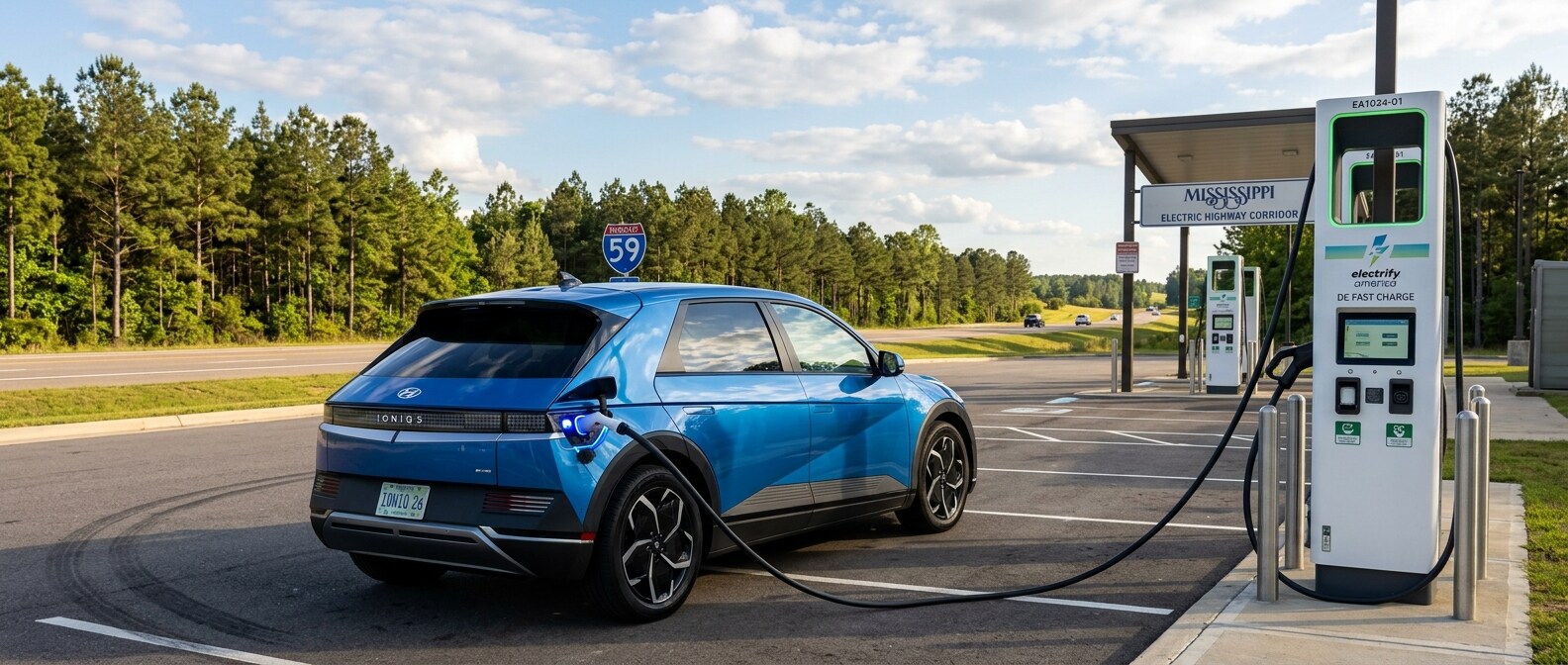
You've done the daily commute on electrons. The charge-at-home routine is second nature by now, and the I-55 run from Ridgeland to downtown Jackson barely registers as something to think about. A longer trip, though, is a different calculation. The IONIQ 5 and the IONIQ 9 are seriously capable road-trip vehicles, and we want to show you what that means in practice for a driver leaving north-metro Jackson, so you're making real decisions with real numbers instead of guessing.
Our short version runs like this. Aim your stops at an 80 percent state of charge and skip waiting on a full 100. Lean on the in-vehicle navigation's route planner over any third-party app. And know that Mississippi's DC fast-charging infrastructure along I-55 works but isn't dense, so a few minutes of route planning before you leave beats any amount of improvising at the charger.
How Far Will Your Hyundai EV Really Go on a Mississippi Highway Run?
The EPA estimate is a solid baseline, but it isn't a highway guarantee, so your real road-trip range will land under the sticker number once you're holding interstate speed for a while. Plan around that gap first, because it decides where and when you stop more than any other single factor.
The EPA rates the 2026 IONIQ 5 Long Range RWD at 318 miles of estimated range, and the 2026 IONIQ 9 S RWD at 335 miles. Those figures are real, and they're earned in mixed driving. At 70 to 75 mph on a sustained interstate run, which is exactly what I-55 south toward Hattiesburg or I-20 west toward Vicksburg looks like. Expect real-world range closer to 255 to 275 miles on the IONIQ 5 Long Range RWD. The IONIQ 9 behaves much the same. None of that signals a weak vehicle. Aerodynamic drag is doing what physics says it does at speed.
In practice, build your trip around roughly 250 miles as your comfortable stop interval, well under the 318 figure. You'll carry a useful buffer when you roll into a charger.
| Model / Trim | EPA Range (est.) | Practical Highway Interval | Battery |
|---|---|---|---|
| 2026 IONIQ 5 SE Standard Range RWD | 245 mi | ~195 mi highway | 63 kWh |
| 2026 IONIQ 5 Long Range RWD | 318 mi | ~250-270 mi highway | 84 kWh |
| 2026 IONIQ 5 Long Range AWD | 290 mi | ~235-250 mi highway | 84 kWh |
| 2026 IONIQ 9 S RWD | 335 mi | ~265-280 mi highway | 110.3 kWh |
| 2026 IONIQ 9 AWD SE / SEL | 320 mi | ~255-270 mi highway | 110.3 kWh |
A/C and Mississippi heat: A fair thing to sort out before a summer trip is how much cooling costs you. Air conditioning draws far less from an EV battery than a cabin heater does. Good news. Running the A/C through a humid August afternoon will trim range, though it won't reshape your trip plan the way a freezing January up north would. Plan conservatively, precondition the cabin while you're still plugged in at home, and you'll be fine.
Where Do You Charge on the I-55 Corridor and Beyond?
Charging access is what makes or breaks a Hyundai EV road trip out of Ridgeland, and your 2026 model opens up far more of the map than older EVs could, but Mississippi's public network still clusters in a handful of spots and does not spread out evenly across the state. Plan around that pattern and you're set.
Our IONIQ 5 and IONIQ 9 inventory carries a native NACS port on every 2026 model, which opens up Tesla Supercharger access alongside the growing CCS network. Access like that matters, because Mississippi's public DC fast-charging footprint works well, though it won't spread evenly across the state.
Heading south from Ridgeland, here's how the corridor breaks down.
| Leg / Direction | Station | Type | Key Detail |
|---|---|---|---|
| Jackson (south, off I-55) | Electrify America Jackson Metro Junction | 350 kW CCS, 6 stalls | Fastest option in the metro; 4888 Hwy 18 |
| Hattiesburg (~90 mi south) | Tesla Supercharger, Turtle Creek Crossing | NACS, 8 stalls | Good mid-point south to the Gulf Coast |
| McComb (~100 mi south of Jackson) | Tesla Supercharger, Southwest Mall | NACS, 8 stalls | Useful for I-55 runs toward Louisiana |
| Grenada (~75 mi north of Jackson) | Tesla Supercharger, Sayle C-Store | NACS, 8 stalls | I-55 north toward Memphis |
| Ridgeland (overnight / destination) | Tesla Destination, Embassy Suites | Level 2 | 200 Township Ave; not a road-trip fast charger |
A few practical notes on that table. The Embassy Suites in Ridgeland has Tesla Destination charging, which runs at Level 2 instead of DC fast. For an overnight stay where you plug in and wake up to a full battery, it's ideal. For a 20-minute top-off mid-trip, it won't do the job. Know the difference before you pull in.
The Electrify America station in Jackson runs on CCS. Your 2026 IONIQ 5 or IONIQ 9 ships with a CCS adapter in the box, so you're covered. Thanks to the 800-volt architecture in both models, a 350 kW-capable station charges the IONIQ 5 Long Range from 10 to 80 percent in approximately 20 minutes. The IONIQ 9 hits that same window in about 24 minutes. Call it a meal, a coffee, a quick walk. At a Tesla V3 Supercharger through the native NACS port (no adapter needed), Hyundai puts the IONIQ 9's 10-to-80 time at approximately 40 minutes, still a usable road-trip stop, just longer than the 350 kW figure.
The Natchez Trace Parkway is a different story. It runs right through Ridgeland and makes for a beautiful drive, but the Trace itself has almost no DC fast-charging infrastructure along the route. If you're planning a Trace excursion, charge fully in Ridgeland before you get on, know your destination, and confirm Level 2 options at your planned stopping points. The Trace rewards preparation.
Schedule a Pre-Trip Service Check
Before any long trip: confirm your IONIQ 5 or IONIQ 9 is running at peak efficiency. Tire pressure, battery preconditioning settings, and software version all affect real-world range. Our team can walk you through the vehicle settings that matter most before you leave.
On an 800V-capable 350 kW DC fast charger, the 2026 IONIQ 5 Long Range charges from 10 to 80 percent in approximately 20 minutes, adding roughly 230 miles of EPA-estimated range in the time it takes to get lunch.
Plan It This Way: A Practical Framework Before You Leave
A smooth EV road trip really comes down to planning the charging stops before you leave rather than reacting once the range estimate starts dropping, and even on the rare day a charger sits broken or occupied, the built-in buffer keeps you moving to the next one. Below is how we'd set up a run from Ridgeland.
Start fully charged. For a road trip specifically, charge to 100 percent the night before. Normal daily use is better kept between 20 and 80 to extend battery health over time, but road-trip day is exactly when a full charge makes sense, and the occasional full charge doesn't harm the battery.
Use the in-vehicle navigation's EV route planner. Both the IONIQ 5 and IONIQ 9 have built-in route planners that factor in your current battery level, the weather, and charger locations, then prompt stops at the right intervals. Set your destination before you pull out of the driveway. The system accounts for things a manual calculation misses.
Plan around 80 percent at your destination charger, not zero. Arrive at each charging stop with roughly 15 to 20 percent remaining. A buffer like that means a broken or occupied stall won't strand you, since you've still got enough to reach the next option. Our service team recommends identifying a backup charger at each stop when you're traveling through areas with limited stations, which is most of Mississippi outside the I-55 spine.
Charge to 80 percent, then move on. Above 80 percent, the charge rate slows sharply on the NMC battery chemistry both IONIQ models use, which protects cell health. The last 20 percent takes as long as the first 70. Unless you truly need every mile, leave at 80 and pick up the rest at your next stop. You'll shave time off the whole run.
Check charger status before you arrive. The MyHyundai app and PlugShare both show real-time charger status. Five minutes of checking before you leave each stop pays off. The IONIQ 9's onboard system handles this on its own when you've set a destination, but it's good practice to glance at the app as a secondary check.
Frequently Asked Questions
What's the real-world range of a 2026 Hyundai IONIQ 5 on the interstate?
At sustained highway speeds of 70 to 75 mph in mild weather, the 2026 IONIQ 5 Long Range RWD delivers roughly 255 to 275 miles of real-world range, compared to its EPA-estimated 318 miles. Plan your charging stops around 250 miles as a comfortable interval so you arrive at each charger with a useful buffer. Cold weather narrows that figure further, but Mississippi winters rarely create the severe cold-weather penalties you'd see in northern states.
Can a 2026 Hyundai IONIQ 5 or IONIQ 9 use Tesla Superchargers?
Yes. Both the 2026 IONIQ 5 and 2026 IONIQ 9 come with a native NACS (North American Charging Standard) port as standard equipment, which plugs directly into Tesla Supercharger stalls without any adapter. At a Tesla V3 Supercharger, Hyundai rates the IONIQ 9's 10-to-80-percent charge time at approximately 40 minutes. At an 800V-capable 350 kW DC fast charger, the IONIQ 5 Long Range reaches 10 to 80 percent in approximately 20 minutes. The IONIQ 9 hits that window in about 24 minutes at the same charger type.
Should I charge to 100 percent before a road trip?
For a road trip specifically, yes. Start with a full charge. The guidance to stay between 20 and 80 percent applies to daily charging habits to preserve long-term battery health. Charging to 100 percent occasionally for a trip doesn't cause meaningful harm. What matters more on the road is resisting the urge to wait at a charger past 80 percent. The rate slows sharply above that point, and in the time it takes to go from 80 to 100 at a public DC fast charger, you could have driven to your next stop and started a fresh 10-to-80 session.
Categories:
Social


