


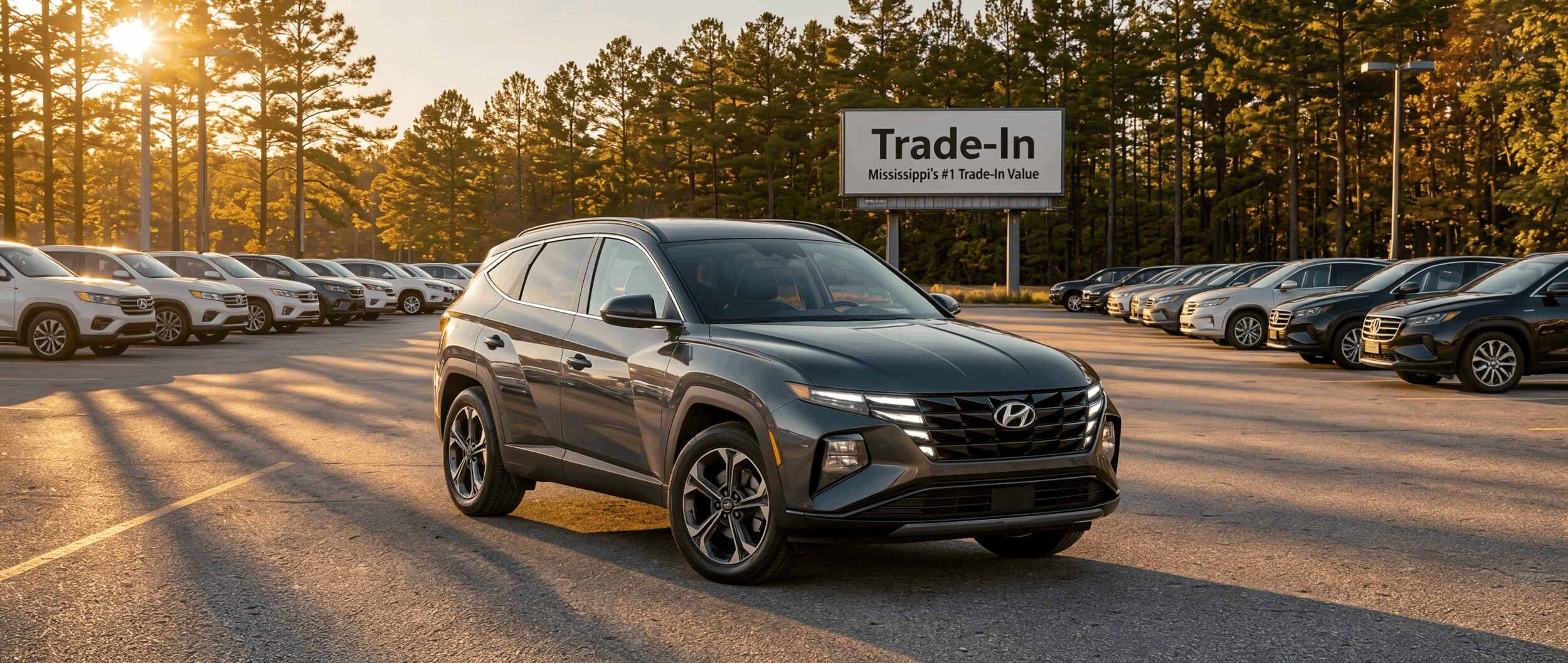
If you're sitting on a Hyundai you've been meaning to move, now is a genuinely good window. We don't say that lightly. Three things overlap in November and December that don't line up at any other point. Dealers are building used inventory for year-end demand, Mississippi's full trade-in tax credit only applies when the trade and the new vehicle land on the same contract, and a vehicle crosses a calendar-year threshold in January that can quietly trim its appraised condition tier.
A fair question before you walk in isn't "should I trade?" It's "what do I actually need to figure out first?" So here they are, ranked by what trips folks up the most. Question one is the one that costs you money when you skip it.
How These 7 Questions Are Ranked
We rank these by impact, putting the questions most likely to change the size of your offer or your out-of-pocket cost first and the paperwork-and-timing ones last. Work through them in order and you'll walk in with a realistic number and no surprises.
| Rank | Question | Why It Matters | What to Do |
|---|---|---|---|
| 1 | Does Mississippi's trade-in tax credit apply to my deal? | Per the MS Department of Revenue, the 5% vehicle sales tax applies to the net price after the trade-in is deducted, not the full purchase price | Confirm the trade and new vehicle are on the same contract |
| 2 | What is my vehicle's real condition tier? | Condition drives appraisal range more than any other single factor | Do an honest self-inspection before anyone else does |
| 3 | Do I owe more than the vehicle is worth? | Negative equity doesn't disappear. It rolls into the next deal | Pull your payoff quote from your lender today |
| 4 | Is my Hyundai a hybrid or a higher-demand model? | Tucson Hybrid and Sonata Hybrid appraisals tend to run higher than base trims in this market | Know which trim you have before you get a number |
| 5 | Does waiting until December help or hurt? | December adds quarter-end and year-end pressure on dealers, but costs your vehicle another month of depreciation | Understand the timing math before you delay |
| 6 | What paperwork do I need? | Missing a title or a second key can slow the process or reduce your offer | Gather everything before you come in |
| 7 | Private sale vs. dealership trade: does the math actually favor selling privately? | Mississippi's tax credit changes the comparison significantly | Run the net numbers, not just the offer numbers |
1. The Mississippi Tax Credit Is Real Money
Mississippi's trade-in tax credit is the detail that surprises buyers most, and skipping it is the costliest mistake a Ridgeland or Madison driver can make, since the state applies its tax to a smaller number once your trade comes off the price. Get it right and you keep real money.
Mississippi applies its 5% vehicle sales tax to the net purchase price after your trade-in value comes off, per the Mississippi Department of Revenue. So if your Hyundai appraises at a solid number and you're buying a new Palisade or Tucson, you're paying 5% on a considerably smaller taxable amount. The trade and the new vehicle have to be on the same contract for the credit to apply. Walk in without understanding that and you might separate the two transactions trying to "negotiate better", and hand that savings back.
Practically, the higher your trade-in value, the more this matters. A well-maintained 2022 or 2023 Hyundai SUV can represent a meaningful reduction in your taxable purchase price. Run the math before you decide anything.
A note on the contract timing. Mississippi law requires the trade-in and the new vehicle purchase to be on the same contract to qualify for the tax credit. Appraising your trade separately on a Monday and returning to buy on a Friday may not qualify under the same transaction. Confirm this with our team before you structure the deal.
2. What Your Condition Tier Actually Looks Like
Appraisers sort every trade into a tier, clean, average, or rough, and those tiers aren't arbitrary, since they reflect what the vehicle will cost the dealer to recondition and resell. Moving from "rough" to "average" on a Hyundai SUV can shift an offer by hundreds of dollars in either direction.
Before mileage or model year, our team starts with these.
- Paint condition: deep scratches or rock chips beyond minor road wear
- Interior: stained or torn seating, cracked or heavily worn dashboard surfaces
- Tires: uneven tread wear signals an alignment or suspension issue to an appraiser
- Glass: a chipped windshield is a known repair cost that comes off the offer
- Warning lights: any active light on the dash means an unknown repair cost
The I-55 commute between Ridgeland and the I-220 interchange is stop-and-go by nature, and that kind of driving adds brake wear and transmission cycles faster than highway miles do. If your vehicle has been your primary I-55 commuter, an honest look at brake pad depth and tire tread is worth doing before anyone else does it.
Get Your Instant Trade-In Offer
3. Negative Equity: Know Before You Go
Negative equity is the question people least want to think about, and it's worth thinking about anyway, because owing more than your vehicle appraises for follows you into the next deal whether you plan for it or not. Knowing the gap up front is what keeps it from surprising you.
If you owe more on your current vehicle than it appraises for, that difference doesn't disappear. It rolls into the financing on your next deal. That isn't necessarily a reason to hold off, and sometimes trading is still the right move, but walking in without knowing your payoff means you can't evaluate what you're actually agreeing to.
Pull your payoff quote from your lender before you come in. It takes about five minutes online or by phone. Compared against your trade estimate, that number tells you exactly where you stand.
4. Hybrid Models Appraise Differently
Hybrid Hyundais appraise differently in this market right now, with Tucson Hybrid and Sonata Hybrid trims holding stronger than their base-trim counterparts, because fuel efficiency still pulls used-vehicle buyers. A well-maintained hybrid with clean service records tends to land at the top of its condition range rather than the middle.
If you're unsure which trim you own, check your window sticker or your original purchase documents. "Hybrid" or "Hybrid Limited" appears in the trim name. It matters to your number.
On the flip side, maybe you've been considering moving out of a hybrid into a fully electric option, say a 2026 IONIQ 5. Late November is a reasonable moment to have that conversation, since your hybrid still holds strong residual value and the new IONIQ 5 carries current-model-year availability at this store.
5. November vs. December: The Honest Timing Answer
November or December is a real tradeoff, and we'll give it to you straight, because the later month brings more dealer pressure while your trade ages another month in the meantime. Both pulls are genuine, and which one wins depends on your vehicle.
December brings more dealer pressure (month-end, quarter-end, and year-end land at once), and that pressure can show up in how deals come together on a new vehicle. Your trade-in vehicle also ages another month. A vehicle that appraises in a strong condition tier in November is the same vehicle in December, unless something happens to it, or unless accumulated mileage tips it into a different bracket. For a driver on the I-55 corridor logging a typical commute, the difference is probably not dramatic. But it's real.
The stronger argument for acting in November is simpler. You don't wait for December and then run out of time before year-end closes.
We've watched that runway get tight. Paperwork, payoff quotes, finding the right incoming vehicle, that all takes a few days at minimum, so starting in November gives you room.
- Waiting for December: potential for more new-vehicle deal pressure
- Acting in November: your trade is at its current condition tier, more selection, no last-week scramble
- Best outcome: start the process now, finalize by mid-December
6. What to Bring With You
A trade-in appraisal slows down more from missing documents than almost anything else, so bring the paperwork that lets us move quickly. Have these ready before you come in.
- Your vehicle title (or your lender's payoff information if you're financing)
- Current vehicle registration
- Both sets of keys and any original factory accessories
- Service records (even partial records help; a documented maintenance history shows up in the appraisal)
- Your driver's license and proof of insurance
A missing second key is a known deduction, and dealers account for the replacement cost in the offer. If you have it and left it at home, that's a fixable problem. If you genuinely don't have it, knowing that in advance lets you factor it into your expectations.
7. Private Sale vs. Trade-In: Run the Net Number
Private sale versus trade-in comes down to the net number, and a private sale can produce a higher gross offer than a dealership trade, but in Mississippi trading in at a licensed dealer hands you the 5% sales tax credit on your next purchase. That credit doesn't exist in a private transaction. The buyer of your vehicle pays no tax benefit to you, and you'd pay 5% on the full purchase price of your next vehicle when you buy separately.
Running the net math looks like this. Compare the private sale offer against the dealer trade-in offer plus the tax credit you'd receive. On a well-valued Hyundai SUV, that combined figure often comes closer than the raw offer comparison suggests. It doesn't always favor the trade. But you need to run both numbers before you decide, not just the headline offers.
That's the straight answer, and it's worth having before you post anything on a third-party listing.
The Bottom Line: Start With Your Appraisal Number
A good decision starts with a real number, and the questions above give you the context while the instant cash offer tool gives you the starting point. Come in knowing your condition tier, your payoff balance, and whether your vehicle is a hybrid. Those three pieces of information put you in the best position before any conversation starts.
We're at 450 Steed Rd in Ridgeland. Call our sales team at (601) 856-6423 with questions before you come in, or start your trade estimate online and let us take it from there.
By the Hallmark Hyundai North Team | November 2026
Categories:
Social


