


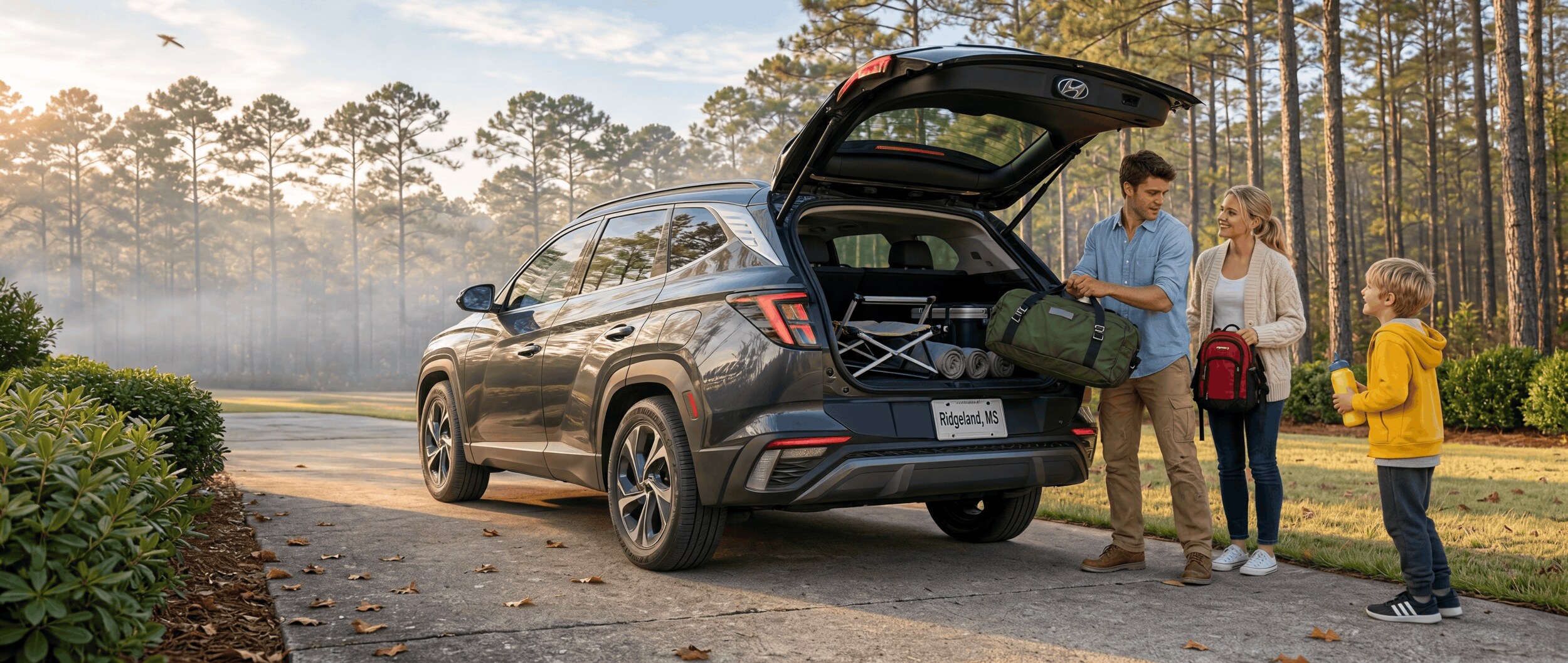
Shopping by life stage misses the point. What matters is whether the car you're driving now still fits the household you have today.
Picture a couple that adds a child. The sedan's 14.2-cubic-foot trunk works fine for two adults, but it can't absorb a stroller, a diaper bag, and a week's groceries at the same time. Or the kids leave for college, and a family paying for three rows they no longer use starts asking why. Sometimes the answer is to trade up, and sometimes it's to trade sideways for something that fits better. The 2026 Elantra still makes genuine sense for plenty of north-metro Ridgeland households. The I-55 corridor from Ridgeland to Madison runs stop-and-go in the morning rush, and a compact sedan handles that commute with less mass to move and a 35-mpg combined estimate (SE) the SUVs in this lineup can't match. Usable cargo space is the real trade-off, and whether that matters comes down to your household.
Here's a direct way to see which side of that threshold you're on.
The 2026 Hyundai Lineup Matched by Household Stage
Each row below pairs a household stage with the Hyundai that genuinely fits it, and the 'honest limit' column tells you where that model runs out of room, so the ceiling shows up as plainly as the headline numbers do. Every figure reflects verified dimensions and real seating capacity, so you can read the tradeoff both ways before you've walked a single lot.
| Household Stage | Best Fit | Cargo / Seating | Honest Limit |
|---|---|---|---|
| Solo or couple, daily I-55 commuter | 2026 Elantra | 14.2 cu ft trunk, 5 seats | Tight on a loaded grocery run; no room for bulky gear |
| Small family, one or two car seats, occasional hauling | 2026 Tucson | 38.7 cu ft behind rear seats, 5 seats | No third row; carpools max out at five |
| Growing family needing a third row at least sometimes | 2026 Santa Fe | 40.5 cu ft behind 2nd row, up to 7 seats | Third-row adults find legroom tight on longer runs |
| Large family, regular third-row use, weekend towing | 2026 Palisade | 46.3 cu ft behind 2nd row, 7-8 seats | Bigger footprint means tighter parking in older Madison lots |
Moving from Elantra to Tucson changes the everyday math, and the badge is the least of it. You go from 14.2 cubic feet to 38.7 behind the rear seats, nearly 25 cubic feet of real added cargo volume. If two car seats and a stroller are your everyday reality, the Elantra's trunk stops being a minor inconvenience and becomes a daily logistical problem you can't ignore. The Tucson solves that without asking you to pay for a vehicle two classes larger.
The One Question That Narrows the Choice
Before you ever compare trim levels or powertrain options, one simple question does more work than the entire spec sheet, and it cuts in both directions at once, telling you where you've got room to go smaller and where you genuinely need to go bigger. Count how many seats in your next vehicle will carry an actual person on a regular basis, and let that answer set your floor on size while everything else fine-tunes it.
Run it in this order.
- Count actual passengers, not theoretical ones. Two adults who carpool now and then need different seating than a family of five in weekly rotation. Tally who you move every week, and don't bother logging the hypotheticals.
- Write down the cargo you carry on every trip. One car seat and a laptop bag fit in an Elantra. Two rear-facing car seats, a double stroller, and a Costco run do not. Put it on paper before you're on the lot.
- Think through the commute math. If your daily run is Ridgeland to Jackson and back on I-55, the Elantra's fuel economy adds up over a year. The gap narrows on pure highway miles, but it's real in stop-and-go.
- Look three years out, not just today. A family expecting a second child in eighteen months isn't really shopping for a Tucson. They may be better served by the 2026 Santa Fe now, before the transition forces a second trade-in.
- Then check what's on the lot right now. Trim, hybrid vs. standard, color (the fun part) come once you've settled the capacity question. Browse our current Hyundai inventory to see what's available before you come in.
Team observation: A household can end up regretting the upgrade when it buys more vehicle than its daily use requires. A Palisade for one adult on a solo commute is real money tied up in empty seats. The Elantra does that job well and does it efficiently. Know which problem you're actually solving.
Get the Size Right, Then Get the Terms Right
The Palisade earns its size for the household that truly runs three rows, with 86.7 cubic feet of maximum cargo capacity (with both rear rows folded) and seating for 7 or 8, yet all that room works against you the day your third row only carries air. If your third row will only see luggage twice a year, the Santa Fe does the same job in a smaller footprint with better daily fuel economy. When two rows cover what you're driving every day, the Tucson is the right call, and nothing about the Palisade would improve that commute. Explore your financing options once you've settled on the model that fits the household you have today, and worry about the next stage when it gets here.
Find Out What Your Current Vehicle Is Worth
Your household changed. Your vehicle can too. We'll match you to the right 2026 Hyundai for the life you're running right now, and that starts with an honest look at what the household actually needs today.
Categories:
Social


