


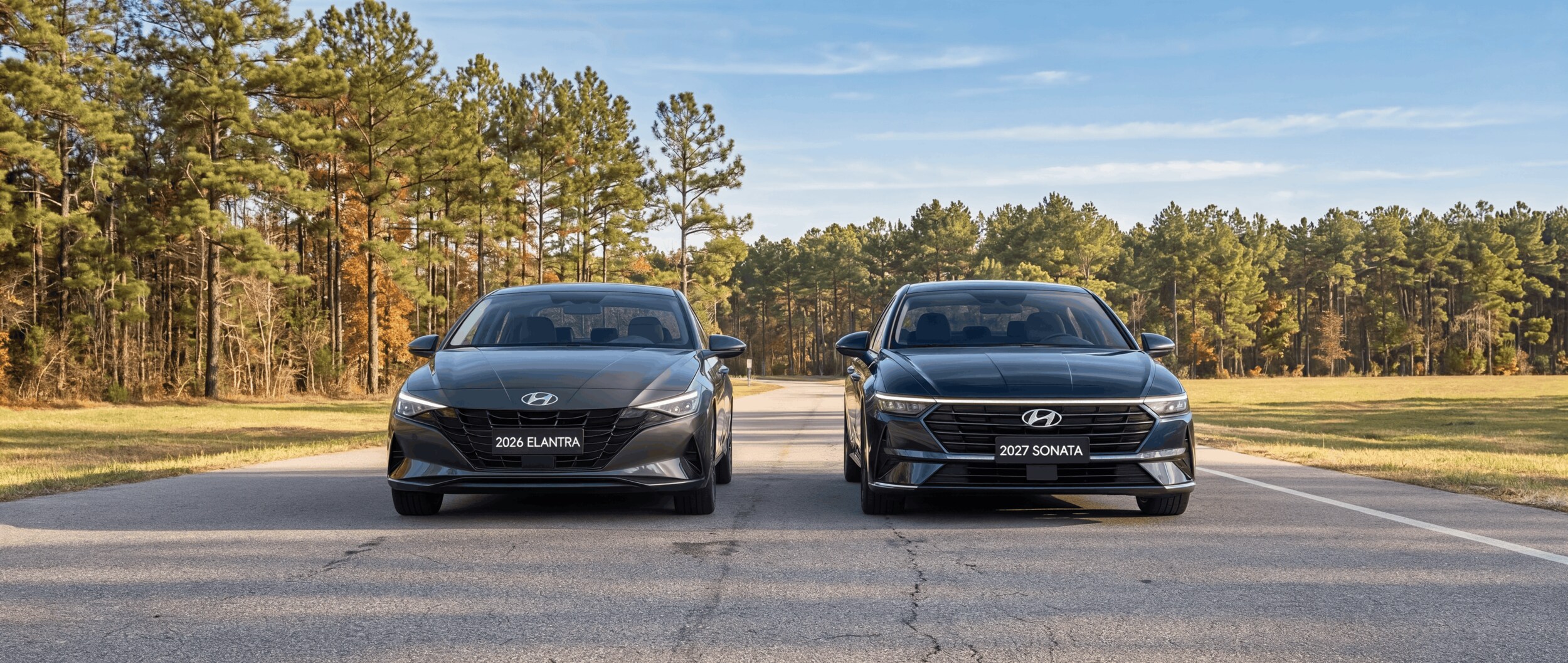
Same brand, similar tech, and two different answers to what a sedan should do. Before you shop, a fair question is which size actually fits your week. The 2026 Elantra is a sharper, more efficient compact that rewards solo commuters. Same badge, different cars. The 2027 Sonata is a midsize sedan with more trunk room, a bigger cabin overall, and a more relaxed highway ride, and it's the one you'll notice first in a parking lot.
The short version
- The 2026 Elantra SE is rated at 35 mpg combined; the 2027 Sonata SE comes in at 31 combined.
- The Sonata carries more cargo (15.6 cu ft vs. 14.2 cu ft) and more total interior volume.
- One counterintuitive number: the Elantra offers more rear legroom (38.0 in) than the Sonata (34.8 in).
- I-55 solo commuters and fuel-focused drivers lean Elantra; families who regularly pack the trunk or carry adult passengers on longer runs lean Sonata.
- One timing note: the 2027 Elantra was just revealed at the LA Auto Show. It won't reach US dealers until 2027, so this comparison uses the 2026 Elantra currently for sale.
What's the Real Difference Between These Two?
They're siblings rather than twins, and the split comes down to size and intent. The 2026 Elantra is a compact sedan built around efficiency and a tight, sporty footprint, while the 2027 Sonata is a true midsize with a 193.3-inch length, a 111.8-inch wheelbase, and 15.6 cubic feet of trunk space. Put them in a parking lot and the Sonata is visibly larger. Put them on a spreadsheet and a few surprises emerge.
| Feature | 2026 Elantra (SE) | 2027 Sonata (SE) |
|---|---|---|
| Body class | Compact sedan | Midsize sedan |
| Engine (base) | 147-hp 2.0L 4-cyl | 191-hp 2.5L 4-cyl |
| MPG combined | 35 combined | 31 combined |
| Cargo (trunk) | 14.2 cu ft | 15.6 cu ft |
| Rear legroom | 38.0 in | 34.8 in |
| Passenger volume | 99.4 cu ft | 104.4 cu ft |
| Rear shoulder room | 55.6 in | 56.1 in |
| Hybrid available? | Yes (Elantra Hybrid) | Yes (Sonata Hybrid) |
| AWD available? | No | SEL Sport trim only |
The real inversion: the Sonata wins on overall cabin volume and cargo space, yet the Elantra delivers more rear passenger legroom (38.0 in vs. 34.8 in), a gap that matters on any run longer than 30 minutes.
Does the Bigger Car Always Mean More Back-Seat Room?
Not in this case, and the spec sheet flips the assumption you'd expect. The 2027 Sonata has a longer overall body, more total passenger volume (104.4 cu ft vs. 99.4 cu ft), and slightly wider rear shoulder room (56.1 in vs. 55.6 in). All of that tracks for a midsize.
What breaks the pattern is rear legroom. The 2026 Elantra measures 38.0 inches back there. At 34.8 inches, the Sonata trails by 3.2 inches, a gap a six-footer feels on a 45-minute ride. It's the figure easy to skip in a spec table. The Sonata earns its interior-volume edge through a taller roofline and a wider body, not a longer floor. If you carry adults in the back seat often, that counts for more than the car's overall size.
The cargo story runs the other way, and here the Sonata takes its turn. Its 15.6-cubic-foot trunk beats the Elantra's 14.2 by a margin that shows up on a Costco run, a weekend trip to visit family, or anything beyond a gym bag and a backpack.
Browse current Hyundai sedan inventory to see what's on the lot right now.
How Do Efficiency and Powertrain Stack Up on the Daily Commute?
Fuel efficiency is where the Elantra makes its strongest argument, and it's the right lens for anyone running north-south on I-55 through Ridgeland every day, though the Sonata answers back with real muscle and more room to stretch out.
The 2026 Elantra SE is rated 31 city / 40 highway / 35 combined. The 2027 Sonata SE is rated 26 city / 38 highway / 31 combined. Each car also offers a hybrid variant that pushes well above those gasoline-only figures.
Four more mpg combined at the base trim adds up over a year if you're putting steady daily miles on the car. The Sonata Hybrid Blue trim answers with 51 mpg combined and an estimated driving range of around 673 miles per fill-up (based on a 15.9-gallon tank). The extended range suits drivers who want fewer stops on longer runs between Ridgeland and Canton or beyond.
Powertrain muscle tips toward the Sonata. Its standard 2.5L delivers 191 horsepower against the Elantra's base 147. Both offer turbocharged variants at upper trims. The Elantra N Line reaches 201 hp, while the Sonata N Line makes 290 hp with a wet dual-clutch transmission and 311 lb-ft of torque. They're genuinely different categories of performance.
One real downside sits with the Elantra. Its smaller 12.4-gallon fuel tank means more frequent stops if you're a high-mileage driver. The Sonata's 15.9-gallon tank gives you more range between fill-ups on the gasoline model, too.
Comfort and Cabin Texture Under a Mississippi Summer Sky
Everyday livability in this climate comes down to heat management more than any winter-grip feature, and both cars handle it well. Mississippi summers run long and humid, and they're hard on anyone sitting in a parked car for even a few minutes.
Ventilated front seats come on upper trims of both, and here they'll earn their keep far more than any AWD capability ever would.
On a 45-minute commute in traffic, the Elantra's slightly sportier suspension feels livelier, while the Sonata stays more relaxed and planted at highway speeds. Its wider body (73.2 inches without mirrors) gives front occupants noticeably more shoulder room (57.9 in front vs. 56.5 in the Elantra). For a longer drive to visit family in Jackson or a weekend run, you'll find the Sonata's composure feels more natural.
The honest downside on the Sonata involves drivetrain choice. AWD is available, but only on the SEL Sport trim of the gasoline model. Front-wheel drive handles most Mississippi weather without issue, though if you're heading north in winter months and want extra grip, weigh trim level carefully.
So Which Should You Pick?
The answer depends on your household and your typical week far more than on the badge, so match the car to how your back seat and trunk actually get used. Both are strong, and they're built to solve different problems.
Choose the 2026 Elantra if:
- You commute solo or with one other adult and your rear seat sees occasional, shorter use.
- Fuel efficiency is a genuine priority on your daily I-55 run.
- You want a nimble, well-equipped car with a tighter footprint for city parking.
- The Elantra Hybrid version at 54 mpg combined fits your commute pattern.
Choose the 2027 Sonata if:
- You regularly seat adult passengers who'll feel 3.2 inches of legroom difference on a 45-minute ride (yes, that's the Sonata's rear-seat disadvantage versus the Elantra).
- Trunk space is a weekly reality for your household.
- The Sonata Hybrid's longer range per fill-up makes more sense than the Elantra's higher per-mile efficiency.
- You want the option of AWD (SEL Sport trim) for occasional travel outside the region.
Neither is a compromise. They're just built for different days. The Elantra fits a driver who wants a smart, efficient compact that happens to have better-than-expected back-seat legroom. A Sonata fits a driver who wants midsize confidence, a bigger trunk, and room to grow into on longer family stretches.
Come walk through both. We're on Steed Road in Ridgeland and have both models in stock.
By the Hallmark Hyundai North Team | November 2026
Frequently Asked Questions
Is the Hyundai Sonata or Elantra better for a family?
It depends on how your family actually uses the car. If adults regularly ride in the back seat for longer stretches, the 2026 Elantra's 38.0 inches of rear legroom beats the 2027 Sonata's 34.8 inches. If your family priority is trunk room for strollers, luggage, or gear, the Sonata's 15.6 cubic feet is the right answer. The Sonata also delivers a larger overall cabin (104.4 cu ft passenger volume vs. 99.4 cu ft), which makes the interior feel more spacious even when rear legroom runs shorter. For families who haul more than they seat, the Sonata; for families prioritizing efficiency and rear-seat legroom, the Elantra or its hybrid variant.
Does Hyundai make a hybrid version of both the Elantra and the Sonata?
Yes, both models have hybrid variants on our lot. The 2026 Elantra Hybrid Blue trim is rated at 54 mpg combined, drawing from an 11.0-gallon tank for an estimated range of around 594 miles per fill-up. The 2027 Sonata Hybrid Blue trim is rated at 51 mpg combined, with a larger 15.9-gallon tank that stretches estimated range to around 673 miles. The Elantra Hybrid is the more efficient car per mile; the Sonata Hybrid gives you a longer tank-to-tank range. If you're optimizing for fewer fill-ups on a highway-heavy driving pattern, the Sonata Hybrid has the edge. If you're optimizing for mpg on a daily urban or suburban commute, the Elantra Hybrid wins.
Categories:
Social


