


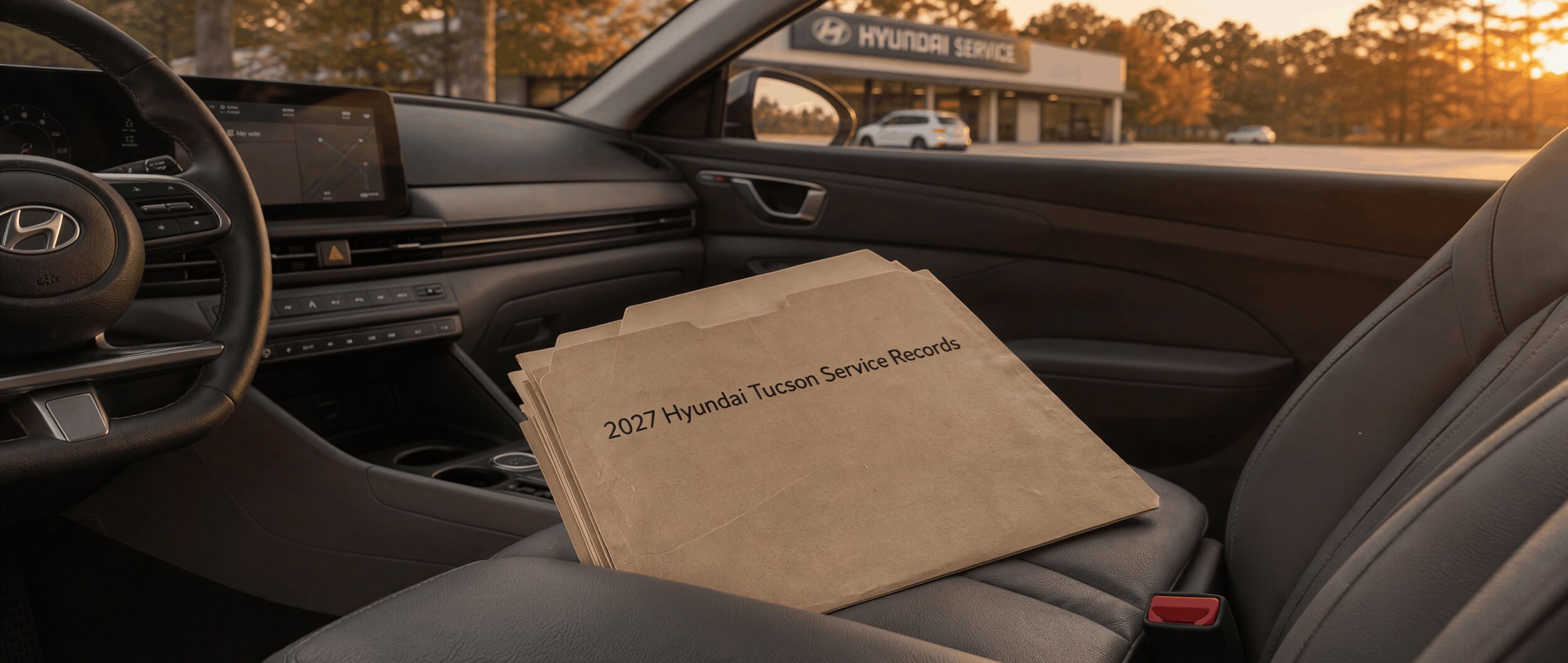
Oil-change receipts tend to end up in a drawer somewhere. A few get scanned to a phone. Plenty vanish entirely, on the assumption that the paperwork doesn't really matter. It matters more than you'd expect, and the reason isn't the one you usually hear.
Here's the short answer. Keeping organized maintenance service records is an owner responsibility, and clear documentation puts you in a stronger position if your service history is ever questioned. That gap between the obligation to keep records and what happens when you don't is where the disputes start. It's why having your paperwork in order matters.
Our service team at Hallmark Hyundai North logs every visit into Hyundai's national system automatically. Still, that doesn't cover you without your own copy. Both copies matter, and here's the reason.
What Does a Service Record Actually Need to Include?
| What to Keep | What It Shows | Why It Holds Up |
|---|---|---|
| Oil change invoices | Date, mileage, oil spec used | Proves the interval was met with the right product |
| Multi-point inspection reports | Condition of brakes, belts, fluids at a given mileage | Documents what was checked, not just what was changed |
| Recall and service campaign paperwork | Specific campaign completed, parts used, date | Closes the loop on a manufacturer-initiated fix |
| Coolant and transmission service records | Fluid type, interval, mileage | Critical for powertrain service history questions |
| Filter replacements (cabin, engine) | Date, mileage | Establishes consistent maintenance pattern |
To hold up in a dispute, an invoice needs three things on it, the shop name and address, your vehicle identification number, and the odometer reading at the time of service, and a receipt that lists the oil brand but not your VIN is worth very little if your history ever gets questioned. Cash register receipts from quick-lube operations frequently leave off at least one of those three.
A Tucson owner running 15,000 miles a year on the I-55 commute will hit oil-change intervals faster than the calendar suggests. Having the mileage documented closes that argument before it starts.
The Honest Truth About Service Records and Your Responsibility
Keeping detailed maintenance service records and receipts is an owner responsibility, and it shapes how your vehicle reads to future buyers, appraisers, and anyone in a service discussion, because work done on your Hyundai counts for the most when it's documented properly at the time it happens.
Without records, you're trying to prove something happened. With records, you hold clear evidence of what was performed and when.
That cleaner footing is a meaningfully different place to stand when any service concern comes up at higher mileage.
Keep in mind: Independent shop invoices count as documentation when they include the right details. Hyundai accepts work orders from non-dealer mechanics. What it won't accept as proof of maintenance is a parts-store receipt alone, because a receipt for oil doesn't prove the oil went in. A dated invoice from the shop does.
Palisade owners and Santa Fe owners carrying families on longer drives tend to run more complex service histories, more fluid intervals, more cabin filter swaps, more brake inspections. Those are also the vehicles where a service question at higher mileage carries the most weight. The paper trail matters more, not less.
- [ ] Oil change invoices, every one with VIN, date, mileage, and shop address
- [ ] Multi-point inspection reports from each service visit
- [ ] Recall and service campaign completion paperwork
- [ ] Coolant service, brake fluid, and transmission fluid records
- [ ] Cabin air filter and engine air filter replacements
- [ ] Any repair orders for completed work
- [ ] Body repair records if your vehicle had collision work done
Schedule a Service Appointment
Resale Leverage: What Records Do for Your Trade-In Value
A Hyundai with a documented service history is a different conversation at trade-in than one without, because buyers and appraisers know the brand's ownership programs are built around long-term care, and they know consistent maintenance documentation is what makes a service history credible. A gap in the records doesn't by itself mean neglect, but it creates doubt, and doubt costs you at trade-in time.
We see this hold in our north-metro market. An owner around Ridgeland who kept every receipt, organized by date, walks into a cleaner appraisal conversation than one who can't account for two years of service intervals. No sales pitch there, just documentation reality.
One note is specific to our market. Ridgeland sits right along the Ross Barnett Reservoir corridor, where summers run humid, with the humidity lingering into the mid-70s even as temperatures climb through the 90s. That kind of sustained heat and moisture (the reservoir keeps the air heavy well into the evening) is harder on cabin air filters, cooling systems, and serpentine belts than a milder climate would be. When a vehicle from this area shows up with no AC service records and no cabin filter documentation, that's a gap that raises real questions. Those same records, if they exist, tell the next buyer the vehicle was cared for in conditions that actually demanded it.
The trade-in appraisal process runs smoother with documentation, and that holds regardless of vehicle age.
Digital Records Are a Backup, Not a Substitute
The MyHyundai owner portal at owners.hyundaiusa.com includes a "Vehicle Health" maintenance timeline, and when you use a Hyundai service provider those visits appear automatically in the account, which makes it genuinely useful for remembering what was done and when. That part earns its keep.
The limitation worth naming is that the digital record only captures dealer network visits. An oil change done right at an independent shop, using the correct specification at the right mileage, won't show up there, because that shop isn't wired into Hyundai's system. Gaps in the portal history don't equal neglect, but they do mean the paper invoice has to fill in what the digital record can't.
A practical system is two-tier. Keep the actual invoice, paper or PDF, for every service visit. Use the MyHyundai portal as a quick reference for dealer-network work. If you've had work done at independent shops, those invoices are your only record, and they need to live somewhere you can find them in three years, not just this week.
Bring your Hyundai in for service here and every visit gets logged in Hyundai's national system, plus the invoice we hand you. Both copies exist.
Frequently Asked Questions About Hyundai Service Records
What makes a good service record?
A solid service record includes the shop name and address, your vehicle's VIN, the odometer reading at the time of service, the date the work was performed, and what was actually done. A receipt from a quick-lube operation that leaves off any of these details won't be as useful if your service history is ever questioned.
Do I have to use a Hyundai dealer for service?
No. You can use an independent mechanic and still keep a complete service history. The difference comes down to documentation. A dealer visit is logged into Hyundai's national system on its own, while an independent shop visit exists only on the invoice they hand you. Keep those invoices. They're your record for any work done outside the dealer network.
How long should I keep service records?
Keep your service records for the life of your ownership, and beyond that if you plan to sell or trade in the vehicle. Buyers and appraisers rely on a complete maintenance history to understand how the vehicle was cared for over time. Organized records make that conversation clearer and usually lead to a better appraisal outcome.
Categories:
Social


