


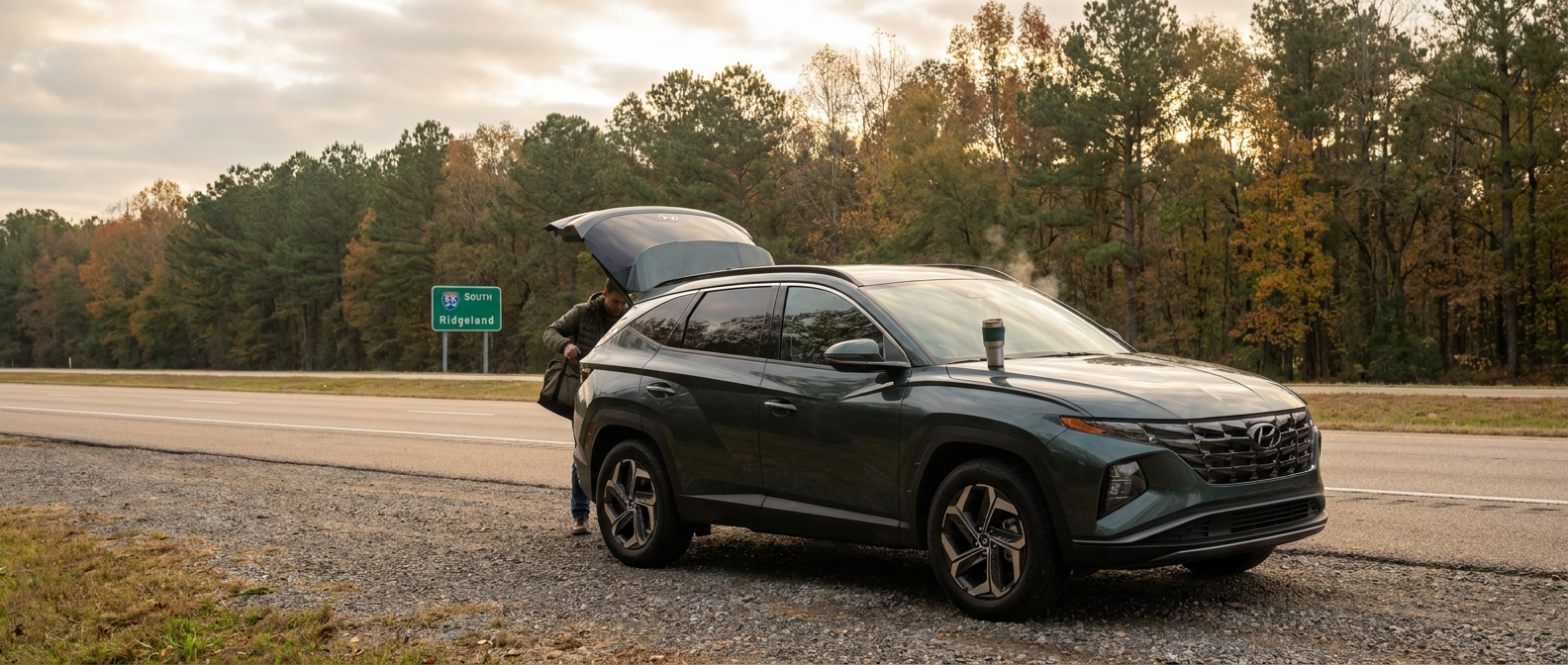
Run five checks before you leave Ridgeland and you're ready for the full I-55 corridor through Madison, Gluckstadt, and Canton and well north of there. That's the short answer. The longer one is that I-55 does two different things to a vehicle, stop-and-go from County Line Road to the I-220 interchange, then a long, open, sustained-speed run once you clear Madison. A generic checklist built for one mode misses what the other one demands. We know this road.
The Hyundai Tucson handles this corridor well, but everything below applies across the Hyundai lineup.
What's the Plan at a Glance?
| Stop or Segment | What to Confirm | Best Time to Check | Notes |
|---|---|---|---|
| Your driveway | Tire pressure (cold read) | Before you start the engine | TPMS reads accurately only when tires are cold |
| County Line Rd to I-220 | Brake fluid condition | At pre-trip service | Stop-and-go cycles stress brake fluid faster than open highway |
| Natchez Trace exit (milepost 101) | Driver-assist settings active | Departure morning | Smart Cruise and Highway Driving Assist set before sustained speed |
| Madison to Canton | Oil life monitor reading | Three to five days out | Catch the interval before you're 30 miles north of anywhere useful |
| Full run | Battery and cabin filter | Pre-trip service visit | November cool-downs surface weak batteries; filter affects cabin air quality |
Tires First, and the Cold-Start Warning That Catches People Off Guard
November mornings in central Mississippi can sit 20 or more degrees cooler than the afternoon high, and that swing matters because tire pressure drops roughly one PSI for every ten-degree Fahrenheit drop in temperature. Your Hyundai's TPMS reads most accurately when the tires are cold, before you've driven more than a mile or two. According to the 2026 Hyundai owner's manual, if tire pressure was set to the recommended level in warm weather, the Low Tire Pressure warning light may illuminate on a cool morning. It is the math of compressed air in cooler air. That is not a malfunction.
Check pressure with a physical gauge before you leave. The recommended PSI is on the sticker inside your driver's door jamb, and it is model-specific. That number is your anchor, not the TPMS light alone. The system will confirm you're in range within a few minutes of driving once it cycles, but it won't replace a driveway gauge check.
Tread is the other piece. November brings fronts and rain through the Madison County stretch of I-55, and standing water on the road demands tread depth. The penny test works. If Lincoln's full head is visible when you insert a penny into the tread groove, you're at or below 2/32 of an inch, which is not the tread profile you want on a wet four-lane highway. Swap them first.
Schedule a pre-trip service check if you want a technician to confirm both pressure and tread before you head north.
From our service team: Most Hyundai models' spare tires do not carry a TPMS sensor. Per Hyundai's documentation, the Low Tire Pressure warning stays on after you install the spare, because the spare has no sensor to report back to the system. Worth knowing before you're on the I-55 shoulder north of Madison, wondering why the light won't clear after you've mounted the spare correctly.
The Canton Stretch Needs Your Fluids in Good Shape
North of the I-220 interchange, I-55 settles into a long open run, and Madison, Gluckstadt, and Canton come at sustained highway speeds. That segment pushes your cooling system, oil, and brake fluid in ways the short-errand driving that fills most weeks never does.
Oil: Your Hyundai's oil life monitor tracks engine load conditions, not just miles. If it's showing under 20 percent or you're within a few hundred miles of your interval, do the change before the trip. A dipstick check tells you even more directly. Dark or gritty oil has been working hard under real-world conditions and deserves fresh oil before a long run.
Coolant: The reservoir has a MIN/MAX range marked on the side. Low coolant on a sustained high-speed run north toward Canton creates a cooling problem with very few good options at that point. Check it cold.
Brake fluid: This one is easy to overlook. Brake fluid absorbs moisture over time, and absorbed moisture lowers the fluid's boiling point. The stop-and-go segment between County Line Road and the I-220 interchange cycles your brakes more intensively than open highway miles do, so you're arriving at the fast stretch with brake fluid that has already done real work. If the fluid in the reservoir looks dark rather than clear-to-amber, a flush before a long run is the right call.
The Hyundai Palisade and other larger three-row configurations carry more weight, so brake loads and fluid demands scale accordingly.
Brake fluid absorbs moisture over time and its boiling point drops as it does; the stop-and-go segment on I-55 between County Line Road and the I-220 interchange cycles brakes more intensively than open-highway miles, making fluid condition a more important check before this specific route than before a pure highway run.
How Your Hyundai's Tech Fits Into the Prep
Your Hyundai's driver-assist features earn a spot on this list because the generic checklists skip them entirely, and on a 60-to-90-minute sustained run they do real work managing the micro-adjustments that pile up into fatigue. Smart Cruise Control with Stop and Go is standard on most current Hyundai trims, and we think it matters here.
It manages exactly the kind of micro-adjustments the Madison-to-Canton stretch produces. It is not autopilot. But knowing it's active on your trim, and how to engage it before you're already at speed, makes the tool useful instead of an afterthought.
Highway Driving Assist, available on higher trim levels, adds lane-centering to the cruise function. If your vehicle has it, the departure morning is when you confirm it's on and calibrated.
Battery is the last thing to get eyes on, and November is the right month to do it in Mississippi. Heat does more cumulative damage to lead-acid batteries than cold does. A long Mississippi summer followed by the first cool mornings of fall is when a marginal battery finally gives out. If yours is three years or older, bring it in for a load test at our service bay before the trip. The answer is quick.
Schedule a Pre-Trip Service Check
The Natchez Trace Detour and What It Adds to the Trip Profile
One reason to prep your Hyundai well for this run is the detour it opens up, because the I-55 exits at milepost 101 in Ridgeland connect directly to the Natchez Trace Parkway, and the Ross Barnett Reservoir is within minutes of that exit. The Reservoir covers more than 33,000 acres with more than 105 miles of shoreline. The Mississippi Crafts Center on Rice Road, off the Trace just north of that interchange, is open daily except major holidays and sits in one of the better spots of hardwood and pine in the area. November is a genuinely good time for that stop. The fall light and the cooler temps make the outdoor sections of the Trace worth the slower pace.
That slower pace also has a practical upside. If you're in a Hyundai Tucson Hybrid, the lower-speed Trace segment is where the hybrid system recovers energy most efficiently. The EPA rates the 2026 Tucson Hybrid FWD at 38 city / 38 highway / 38 combined mpg, and the combined figure reflects a real-world mix of driving modes. Urban and low-speed segments pull toward the city figure, which is the stronger number on this vehicle.
Run the checks, get the Hyundai looked at before you go, and the corridor takes care of itself. The road north from Ridgeland is good. We want your vehicle to be in the same shape as the drive.
Categories:
Social


