


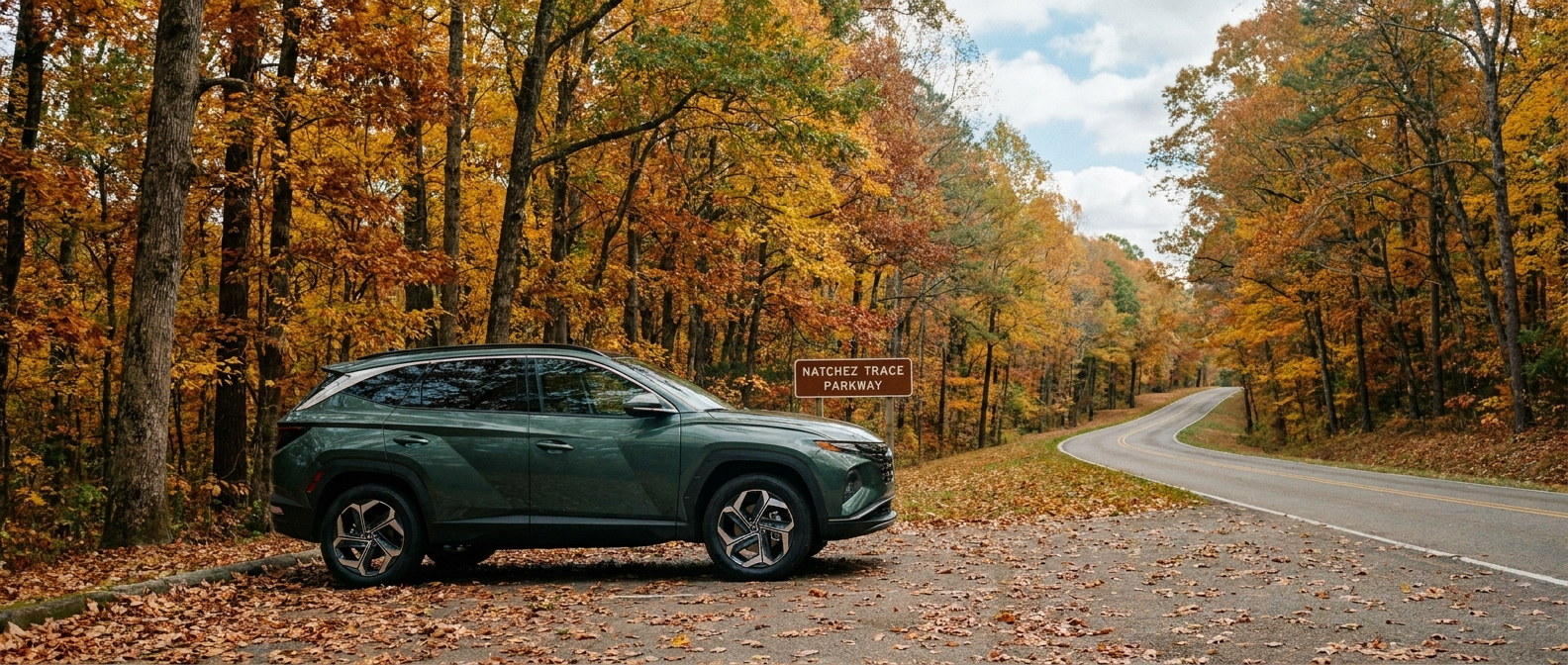
November earns its reputation in central Mississippi. The heat breaks, the Natchez Trace Parkway turns amber and rust, and Thanksgiving travel stacks up fast on I-55. Ridgeland mornings can drop into the mid-to-upper 30s this month before climbing back into the 60s by afternoon, and that swing does something specific to your tires. The Trace, beautiful as it is, has no real shoulder, limited cell coverage in rural sections, and no roadside services along its 444-mile length. Your Hyundai's tires and brakes need to be ready for exactly those conditions right now, and we mean that in a verifiable, specific way.
Here's what actually matters before you go. We'll keep it to checks you can act on.
The short version
- Tread depth: NHTSA sets the legal minimum at 2/32 of an inch, but the NTSB recommends considering replacement below 4/32 of an inch on wet roads. For a November run on a wet I-55 or the Trace, 4/32 is the more honest threshold.
- Tire pressure: Cold-check it against your door-jamb placard before you start the engine. November morning temperature drops of 20-30 degrees in Ridgeland can cost you 2-3 PSI before you've left the driveway.
- Brake pads: Hyundai's maintenance schedules call for a pad and caliper inspection every 8,000 miles. Stop-and-go driving on the I-55 corridor tightens that interval.
- Brake fluid: It absorbs moisture over time, which lowers its effective boiling point. A fluid condition check is part of a full brake inspection and the item drivers skip most often.
- Spare tire: Check it before the Natchez Trace, not after you need it. The Parkway has no roadside services and spotty cell coverage.
Schedule your pre-holiday tire and brake inspection at Hallmark Hyundai North
What actually matters when choosing a tire and brake inspection approach?
The two most common mistakes before a holiday drive are checking tread by eye without measuring it, and treating the TPMS light as a live pressure readout when it only works as a last-resort warning. Either one puts you on the highway with a problem you were sure you didn't have.
| Check | Best for | Key spec | Honest tradeoff |
|---|---|---|---|
| Tread depth with a gauge | Any driver before a long drive, especially on wet roads | NHTSA minimum 2/32 in; NTSB advises replacing below 4/32 in | A gauge is cheap; guessing is not |
| Cold pressure check against door-jamb spec | November mornings before any drive | Pressure drops ~1 PSI per 10 degrees Fahrenheit temperature drop | Door-jamb number is your target, not the sidewall maximum |
| Brake pad and caliper inspection | Anyone near or past 8,000-mile service interval or with a stop-and-go commute | Hyundai's schedule calls for inspection every 8,000 miles | Pad thickness can't be reliably estimated through a wheel spoke |
| Brake fluid condition test | Anyone with Hyundai approaching two or more years on the same fluid | Fluid is hygroscopic and absorbs moisture, lowering its effective boiling point | Easy to defer, genuinely consequential on a long sustained-highway run |
| Spare tire inflation check | Anyone driving the Natchez Trace Parkway | NPS notes cellular coverage is limited to nonexistent in rural Parkway sections; no roadside services on the route | The spare is what nobody checks until the moment they need it |
The quarter test gives you a quick field read on tread depth. Insert a quarter with Washington's head pointing into the groove, and if you can see the top of his head, you're at or below about 4/32 of an inch. NHTSA guidance puts 2/32 as the legal wear limit. The NTSB has separately recommended that drivers consider replacement before that floor, particularly on wet pavement.
Tread depth and tire pressure: two checks you can do in your driveway
A Tucson carrying a full family load on I-55 at highway speed puts a different stress on tires than the daily commute around Ridgeland does, which means tread depth and pressure both read differently at speed, on a wet surface, and under weight. None of that is cause to worry, and all of it is reason to spend two minutes in the driveway before a four-hour drive.
Tread depth. New tires typically start at 10/32 to 11/32 of an inch. By 4/32, wet-pavement stopping distance runs measurably longer than it did when the tires were new. November in central Mississippi isn't snow season, though it averages around nine rainy days per month. Leaf litter on the Natchez Trace over wet pavement behaves differently from dry interstate asphalt. Wet roads stretch stopping distances, and the NPS notes this in its Parkway weather advisories.
Tire pressure. Your door jamb carries a sticker with the correct cold inflation pressure for your specific Hyundai. That sticker number is your target, and it sits well below the maximum rating embossed on the sidewall. On a Ridgeland morning that starts at 38 degrees and climbs to 65 by noon, pressure can shift 2-3 PSI before you've put a mile on the odometer. By the time your TPMS light comes on, the tire already sits well below placard pressure. The light is calibrated to trigger at roughly 25 percent below spec, so treat it as a backup signal and nothing more.
What our service team sees. When a Hyundai comes in on a cool November morning with a TPMS warning, the pressure is often close to spec by the time we check it in a 65-degree bay. The light triggered on a cold tire, then recovered as the air warmed. The recovery still tells you something, because it confirms the tire was underinflated in the actual driving conditions. A cold-driveway check catches what the TPMS misses during the temperature transition. Check it before the engine starts, before the tires warm from road friction.
A Palisade loaded for a Thanksgiving run to north Mississippi rides heavier than the same vehicle empty on a Tuesday. Pressure and tread both matter more under a full load.
- Check tire pressure in the morning before you start the engine, against the door-jamb placard
- Use a manual gauge, since the TPMS works only as a rough backup and won't hand you a precise reading
- Inspect sidewalls for cracks or bulging, along with the tread surface
- Note the DOT date code on the sidewall, where the last four digits give the manufacturing week and year; tires older than six years merit a professional inspection even when tread looks fine
Book a Pre-Holiday Tire and Brake Inspection
Brake pads and fluid: the inspection most people put off
Hyundai's maintenance schedules across the current lineup call for a brake pad, caliper, and rotor inspection every 8,000 miles, per guidance on owners.hyundaiusa.com, and that cadence is your baseline before any long drive. What the interval can't account for is that stop-and-go driving wears pads faster than steady highway miles do. The I-55 corridor between County Line Road and the I-220 interchange runs stop-and-go during peak commute hours by design. If that's your daily route, 8,000 miles can be a generous assumption.
Brake fluid is easy to put off, since nothing about a softening pedal feels dramatic in daily low-speed use. The mechanism is simple enough. Brake fluid is hygroscopic, so it absorbs moisture from the air over time, and that moisture lowers the fluid's effective boiling point. On a long, sustained-highway run, brake systems generate real heat (the kind your daily commute rarely produces), and degraded fluid with a compromised boiling point becomes more susceptible to fade. You feel that as a soft or spongy pedal under repeated heavy use. Easy to miss on the commute, and most noticeable at exactly the moment you don't want it.
Is a brake fluid check just a service upsell? Not necessarily. A tech checks the fluid color and can run a moisture meter to test the actual remaining boiling-point capacity. If the fluid tests clean, you have your answer. If it doesn't, you've got a specific, verifiable reason to replace it before a 400-mile Thanksgiving run, well beyond a vague recommendation.
Match your inspection to how you actually drive
Your prep should track your route, because the Natchez Trace Parkway and I-55 ask different things of a vehicle, and the Parkway asks more. The National Park Service manages all 444 miles of it as a park road, with a 50 mph speed limit, lanes narrower than a standard state highway, and no real shoulder in most stretches. Per NPS advisories, cellular coverage is limited to nonexistent in rural sections. Central Mississippi's portion of the Parkway, including the stretch near Ridgeland, hits peak fall foliage from roughly November 3 through November 20, so right now is peak Trace season. It makes for a beautiful drive, and also one where a tire problem turns inconvenient in a way the same problem on a wide-shoulder interstate doesn't.
If your holiday drive is a pure I-55 run north to Canton, Grenada, or Memphis, make tire pressure and tread depth your top priorities. The highway forgives imperfect prep in ways the Trace won't. If your holiday includes any stretch of the Natchez Trace, add the spare tire, verify the jack and lug wrench are present and functional, and don't defer the brake inspection. The Trace rewards preparation, and it doesn't hand out many recovery options when you skip it.
Our service team can get you in before the holiday travel week
Frequently Asked Questions
Does a TPMS warning light mean my tire needs air, or could it just be the cold?
Both are possible, and that's exactly why the TPMS is a backup signal rather than a real-time pressure gauge. Tire pressure drops approximately 1 PSI for every 10-degree Fahrenheit drop in ambient temperature, per verified tire physics. A Ridgeland morning that's 25 degrees colder than the previous afternoon can trigger the light on tires that are within acceptable range when warm. Check the pressure manually, with a gauge, while the car is cold and before you start the engine. Compare to the door-jamb placard. If it's genuinely low, add air to spec and recheck. If it reads fine cold, you're seeing a temperature effect, not a tire problem. Either way, the manual check is the only thing that resolves the question.
How do I know if my Hyundai's brake pads need attention before a long drive?
You can't reliably judge brake pad thickness by looking through a wheel spoke. Hyundai's maintenance schedules call for a pad, caliper, and rotor inspection every 8,000 miles. If you haven't had that inspection within the last 8,000 miles, or if your daily driving involves a lot of stop-and-go on I-55, that's a concrete, specific reason to get it checked before a long holiday run. A slight pull to one side under braking, or any sponginess in the pedal, are signs worth taking seriously before you leave rather than after.
What should I check on my spare tire before a long holiday drive?
Check spare tire pressure and condition before you need it, especially if you're planning to drive the Natchez Trace. The Parkway has no roadside services and cellular coverage is limited to nonexistent in rural sections. Verify that your jack and lug wrench are present and functional. A spare that's flat or missing when you're 30 miles from the nearest service station is a recovery problem you don't want to face.
FAQ
Does a TPMS warning light mean my tire needs air, or could it just be the cold?
Both are possible. Tire pressure drops approximately 1 PSI for every 10-degree Fahrenheit drop in ambient temperature. A Ridgeland morning that's 25 degrees colder than the previous afternoon can trigger the light on tires that are within acceptable range when warm. Check the pressure manually with a gauge while the car is cold and before you start the engine, and compare to the door-jamb placard.
How do I know if my Hyundai's brake pads need attention before a long drive?
You can't reliably judge brake pad thickness by looking through a wheel spoke. Hyundai's maintenance schedules call for a pad, caliper, and rotor inspection every 8,000 miles. If you haven't had that inspection within the last 8,000 miles, or if your daily driving involves a lot of stop-and-go, that's a concrete reason to get it checked before a long holiday run.
What should I check on my spare tire before a long holiday drive?
Check spare tire pressure and condition before you need it, especially if you're planning to drive the Natchez Trace. Verify that your jack and lug wrench are present and functional. The Parkway has no roadside services and cellular coverage is limited in rural sections.


