


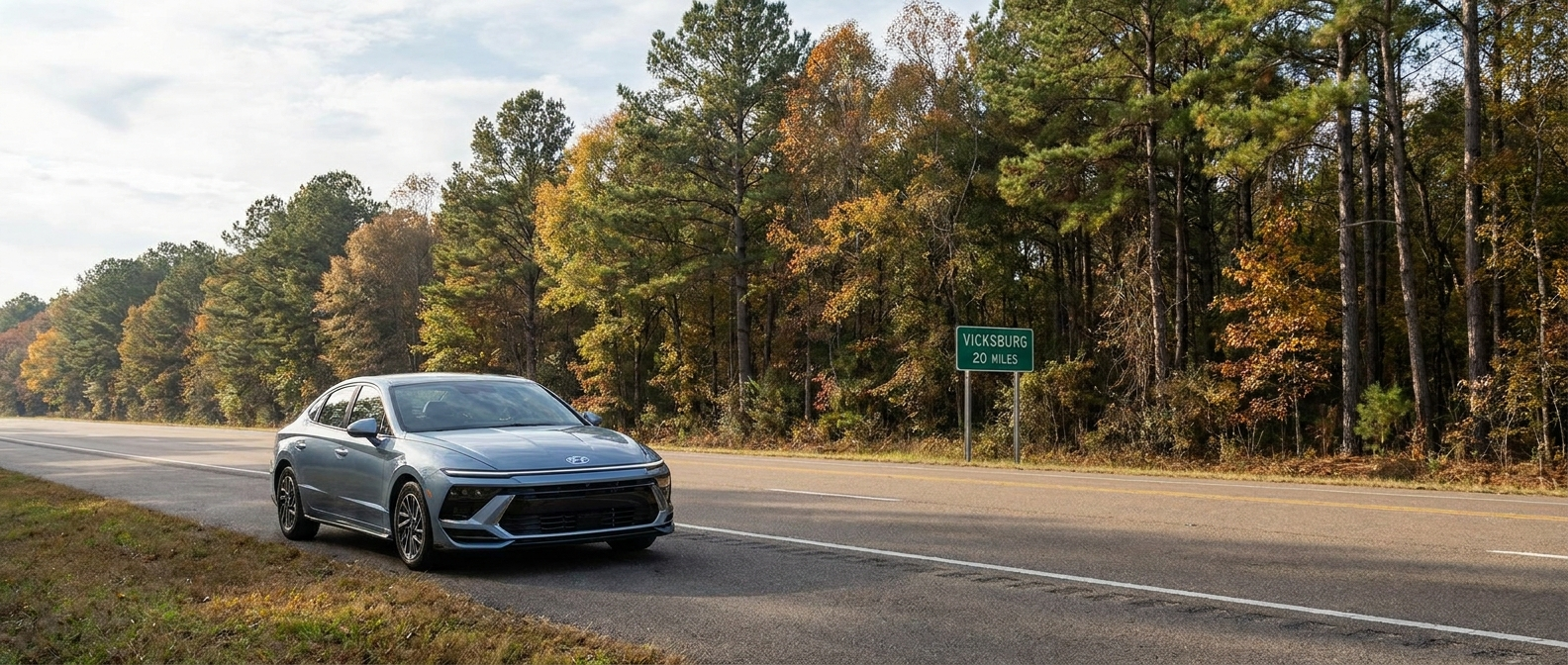
Fifty miles to Vicksburg sounds like nothing, and that's exactly why people skip the prep. The I-55 south to I-220 west to I-20 west corridor looks easy on paper, but you're running sustained highway in November, with morning temperatures in Ridgeland routinely sitting in the upper 30s to low 40s before climbing 25 to 30 degrees by mid-afternoon. That swing does measurable things to your tires. It also exposes deferred oil changes, weak batteries, and cabin air filters that were already overdue. We see it on our service drive, where cars that were fine for the daily commute show their gaps the moment a driver pushes past 45 miles without stopping.
The good news is that Hyundai vehicles match this run well. Let's get into what that actually means for your specific car and this specific trip.
Before this drive, do one thing above all. Check tire pressure cold, against the door-placard spec, the morning you leave, not the night before and not after you've already started the engine.
The Sonata Hybrid is a natural fit for the Vicksburg corridor, and we'll get to why below. The prep principles apply across the whole lineup, though.
Does This Route Actually Need Pre-Trip Attention?
| Local Condition / Use | The Hyundai Feature That Handles It | Why It Matters on This Run |
|---|---|---|
| November morning lows (upper 30s to low 40s in Ridgeland) | Tire Pressure Monitoring System (TPMS) | NHTSA guidance says TPMS only warns when pressure is significantly low, not on a marginal first-cold-morning drop; a manual cold check catches what the light won't |
| Sustained I-20 highway segment at speed | Full synthetic oil at correct service interval | Highway running at steady RPM puts a steady thermal load on engine oil; deferred oil is riskier here than in stop-and-go |
| Vicksburg National Military Park's 16-mile tour road (hilly, start-stop, slow rolling) | Brakes and brake fluid | Repeated low-speed deceleration over 16 miles of tour road is different from freeway cruising; worn pads or old fluid become noticeable |
| Return trip in mid-to-late afternoon (warmer tires, higher pressure than morning) | Understanding door-placard PSI vs. sidewall max | Setting pressure to the sidewall maximum rather than placard spec causes overinflation; placard is the target, not the sidewall number |
| Short urban connector roads through Clinton and Edwards on some return routes | Cabin air filter | A clogged filter reduces A/C and heat effectiveness on the slower connector segments where you're not at highway speed |
| Multi-hour outing with family or bags | Cargo organization, seat adjustments, charging ports | Not a service item, but worth confirming on departure so you're not rearranging at a rest stop |
Tires Are the Highest-Leverage Prep Step
For a short 50-mile run in November central Mississippi, tires are the single place where your pre-trip prep pays off most, and the reason is the morning-to-afternoon temperature swing in this region, which runs large enough to move tire pressure by two to three PSI across one day. Vicksburg isn't the problem. The temperature swing is.
Check your pressure cold, once a month, spare included, exactly as NHTSA's own guidance instructs, meaning the car hasn't been driven for at least three hours. So that points you to a morning-of-departure check rather than a night-before one, when the garage still holds the afternoon's warmth.
NHTSA also notes that the tire pressure monitoring system only warns when a tire is significantly underinflated, so it won't replace the monthly manual check. The TPMS light on your Hyundai dashboard is a late signal. By the time it glows, you're already running well below an optimal range.
NHTSA defines the correct tire pressure as the manufacturer's recommended cold inflation pressure, which lives on the Tire and Loading Information label on the driver's side door edge or door jamb. The number molded into the tire sidewall is a different thing. That sidewall figure is a maximum rating for the tire structure itself, well beyond what your car actually wants.
On the service drive we set tire pressure to the door-placard spec and hold to it for this trip. We check cold, every time.
Schedule a Pre-Trip Service Check
Oil and Engine Basics: The Interval Question
Hyundai's maintenance schedule for 2026 models running full synthetic oil splits into two separate intervals depending on how you actually drive, so the answer for your car depends on your weekly routine, and which side you land on is worth sorting before you default to one. For most 2026 Hyundai models running full synthetic oil, Hyundai lists a normal-condition interval of every 7,500 miles or 12 months, while the severe-condition interval tightens to every 5,000 miles or 6 months.
The two intervals describe different driving. You match it to your conditions.
Severe-condition driving includes lots of short trips under five miles, frequent idling, towing, and extreme temperatures. If your Ridgeland commute is mostly short hops on County Line Road and I-55 surface streets, there's a reasonable argument your driving qualifies as severe by Hyundai's definition. Worth knowing before you default to the longer interval.
One thing genuinely changed for 2026. Hyundai ended its Complimentary Maintenance Program for 2026 model year vehicles and beyond. For 2026 and newer Hyundais, pre-paid maintenance plans are available as an optional purchase. Owners of 2025 and earlier models still hold their coverage, but if you bought a 2026, the responsibility for scheduling that oil change now sits fully on your calendar. We mention this not to alarm anyone, only as a planning fact that affects when you book your next service visit.
"Proper vehicle maintenance, including regular oil and filter changes, is one of the most effective things you can do to extend the life of your vehicle's engine.". U.S. Department of Transportation, Federal Highway Administration, vehicle care guidance
The Tucson and the Palisade both follow this same severe/normal interval split, and the hybrid variants (Tucson Hybrid, Palisade Hybrid) still require oil service on the same schedule even though the combustion engine runs less frequently. The engine still runs. It still needs oil.
On the tour road at Vicksburg National Military Park: the park's self-guided drive covers 16 miles of hilly battlefield terrain with frequent low-speed stops at monuments and overlooks. That's stop-and-go driving on grades. Different from the highway leg that got you there. If your brakes are past their inspection interval, that's the section where you'll notice.
The Sonata Hybrid Fits This Run Well, With One Honest Tradeoff
The Sonata Hybrid suits this particular corridor about as well as anything in the lineup for sustained highway work, and it earns that fit on fuel economy alone, though there's one real catch worth naming up front before you count on it for the whole Vicksburg day. The EPA rates the 2026 Sonata Hybrid at 47 MPG city, 56 MPG highway, and 51 MPG combined (Blue and SEL trims). That highway number matters here, because the I-20 stretch west of Jackson is genuine open highway, sustained-speed driving where hybrids do their best work. At 51 combined MPG, the Ridgeland-to-Vicksburg run and back fits comfortably within a single tank for virtually any Hyundai in the lineup, including the Sonata Hybrid's 13.2-gallon tank.
Now the tradeoff, stated plainly. The Sonata Hybrid is front-wheel drive only. It won't matter on I-20, which MDOT maintains well, but it's a limitation worth knowing if your Vicksburg day extends to gravel areas around some of the park's outer fortifications or the river bluff access points. For those conditions, the Tucson, Tucson Hybrid, or Palisade with available HTRAC all-wheel drive gives you more margin.
What the Sonata Hybrid does well on this route is effortless highway cruising with fuel economy to show for it. The 2.0-liter hybrid system produces 192 combined horsepower, which is more than adequate for I-20 merges and the modest grades heading into Vicksburg. The regenerative braking system also makes the tour road's repeated deceleration work in your favor, since the hybrid recovers energy on the downhills.
Our service team can confirm your specific model's oil type, placard pressure, and brake condition in a single pre-trip inspection visit.
Categories:
Social


