


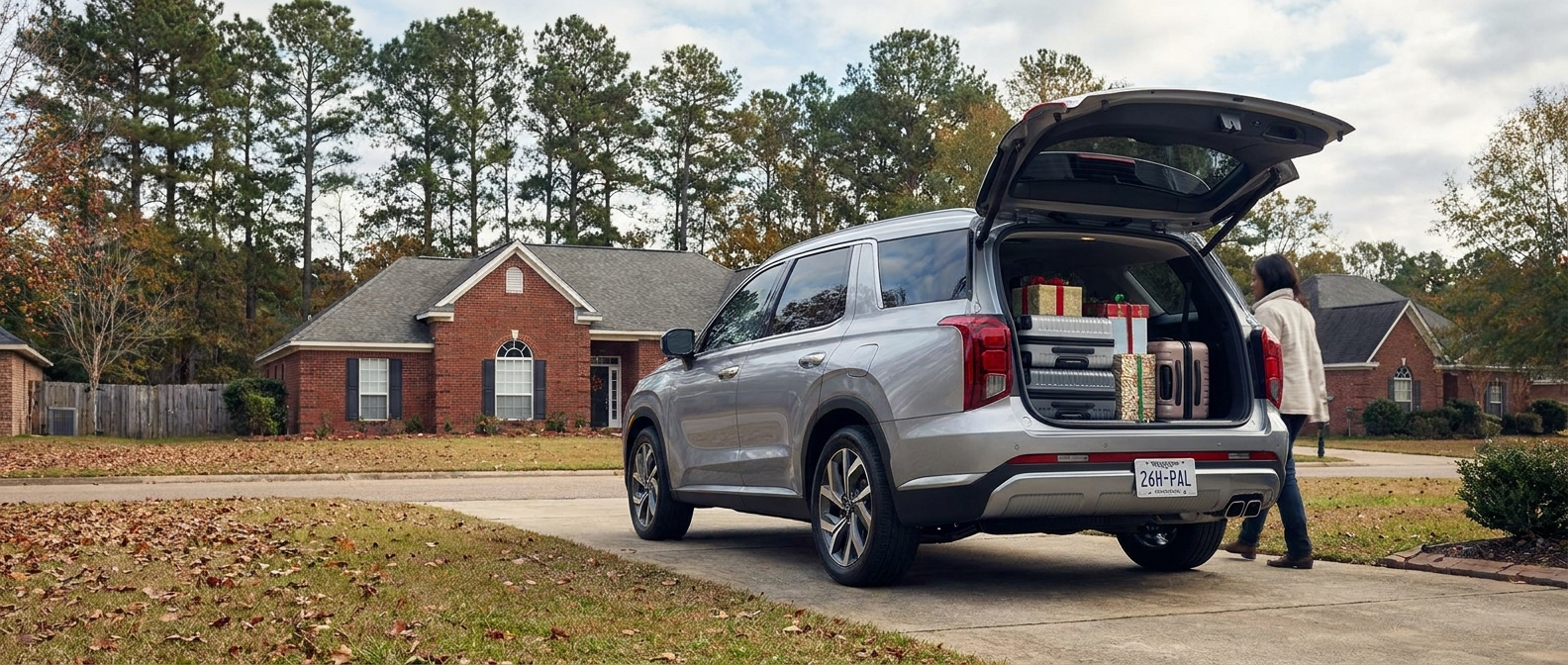
You've got family coming in, gifts going out, and a trunk full of questions. Good news is our Hyundai lineup is built for exactly this kind of load. The tricky part is knowing which configuration to choose before you start shoving bags in.
Do it right and everything fits cleanly. Do it wrong and you're re-packing on the driveway in the dark.
The single most important decision you'll make is whether to fold the third row before you start loading. That choice determines your entire packing strategy, and it has to happen before the first bag goes in.
Whether you're running I-55 up to Canton for a family gathering or heading south for a Thanksgiving run out of the Jackson metro, the Palisade, Santa Fe, and Tucson all reward a little planning. We'll walk through exactly how to do it.
What Do You Need Before You Start?
Before anything goes in the vehicle, do two things. Count your passengers and count your bags, because those two numbers decide your configuration and your usable volume before you lift a single suitcase. Get them right and the plan falls into place. Get them wrong and you're guessing on the driveway.
| Your situation | Recommended configuration | Usable cargo volume |
|---|---|---|
| Palisade, 5 people, third row empty | Fold third row flat | 46.3 cu ft |
| Palisade, 7-8 people, all rows occupied | Third row up, cargo only behind it | 19.1 cu ft |
| Palisade, all rows down (cargo run) | Full flat floor | 86.7 cu ft |
| Santa Fe, 5 people, third row empty | Fold third row flat | 40.5 cu ft |
| Santa Fe, 7 people, all rows occupied | Third row up, cargo only behind it | 14.6 cu ft |
| Tucson (gas), 5 passengers | Rear seats up | 41.2 cu ft |
| Tucson Hybrid, 5 passengers | Rear seats up | 38.7 cu ft |
Cargo figures are Hyundai specifications for the 2026 model year.
You'll also want these on hand:
- Soft-sided duffel bags or compressible luggage (they fill gaps that hard-shell cases can't)
- A trunk organizer or collapsible bin for the deep cargo well
- Stretch cargo nets or bungee loops for the anchor points in the cargo floor
- Any gifts that need to stay upright, identified and separated in advance
The Packing Sequence, Step by Step
Packing order matters more than packing volume, and the common slip is loading bags in the order they reach the car instead of the order they'll come out of it. Follow a set sequence instead, and you load once and unload cleanly at every stop.
Step 1: Confirm your row configuration before anything goes in.
Want the simplest rule? Fold what you're going to fold now, while the vehicle is empty. The Palisade's third row is power-operated on upper trims, and the Santa Fe folds manually but still lies flat. If you're leaving the third row occupied, that choice locks your cargo volume before you touch a bag. In full seven-passenger mode, the Santa Fe gives you 14.6 cubic feet behind that third row.
Call it enough for a few carry-on bags, not a week of luggage. Know that going in.
The Santa Fe Hybrid carries the same cargo numbers as the standard Santa Fe. The Tucson Hybrid comes in just slightly under the gas Tucson at 38.7 cubic feet with seats up versus 41.2. Neither difference is dramatic, but it's worth knowing before you commit to a packing list.
Step 2: Load the heaviest items first, low and against the seatback.
Large suitcases go in flat on the cargo floor, standing upright against the second-row seatback (or the third-row seatback, if it's up). Heavy bags low means a stable center of gravity for the drive and no risk of items sliding onto occupied seats. You'll feel the benefit on the stretch of I-55 from Ridgeland up toward Canton, where the road runs arrow-straight but traffic can change in a hurry around the county line.
Step 3: Fill gaps with soft-sided bags.
Hard-shell luggage is great for protecting contents but terrible for fitting an irregular cargo space. Pack soft duffels, tote bags, and backpacks into the vertical and lateral gaps the rigid cases leave behind. The Tucson's cargo well, at 41.2 cubic feet with seats up, fits three full-size suitcases standing upright with room for two carry-ons across the top. The Palisade Hybrid opens to 46.3 cubic feet with the third row folded, which gives you genuine room for the same load plus a gear bag.
Step 4: Separate the gifts.
Separating the gifts is the easy step to skip, and it's the one that saves you at the first stop. Gifts that need to stay upright, stay unwrapped, or can't be crushed go in last and ride on top. Load them into a collapsible bin or a soft bag with structure so they don't shift. If you're making multiple stops across the north metro (say, Ridgeland to Madison to Canton), load destination order in reverse. The last stop's gifts go in first, and the first stop's gifts go in last. Sounds obvious. At 7 a.m. the day before Thanksgiving, it won't be.
Step 5: Use the cargo anchor points and the underfloor storage.
The Palisade's cargo area includes anchor points in the floor, so use them. A stretch net across the top of a loaded cargo area keeps bags from pitching forward when you brake. The Tucson also has a dual-level cargo floor on most trims. The lower position gives you a deeper well for soft bags, and the raised position creates a flat surface flush with a folded second row. Set it high and loading and unloading feel easy, even when you're working at an angle in a parking lot.
Step 6: Check visibility before you close the liftgate.
Stand behind the vehicle and look through the rear glass. If your rearview mirror view is fully blocked, re-stack. No load is worth compromised sightlines on a holiday weekend on I-55.
The step that's easy to get wrong: Everyone worries about whether the bags fit. The main issue is load order. If the gifts are buried under the luggage, you'll be unpacking the whole vehicle at your first stop. Load in reverse destination order, every time.
A quick note on the Natchez Trace option. If your holiday drive takes you out of Ridgeland onto the Natchez Trace Parkway, speed is capped at 50 mph by National Park Service rules, and that cap works in your favor. A well-loaded cargo area that would shift at highway speed won't get the chance at that pace. But loose items in an unsecured cargo area will still slide on curves. Nets and bins matter regardless of speed.
Insider tip from our service team: Our techs flag this one. After a long holiday drive, an overpacked cargo area that wasn't secured can stress the liftgate seal from the inside when bags are wedged against it. Close the liftgate and check that it latches cleanly before you leave the driveway. If it's fighting you, something is in the way.
Your Pre-Departure Cargo Checklist
Run this list before you close the liftgate, and it catches anything you missed, whether you print it, photograph it, or just read it off your phone. A minute now saves you from unpacking the whole vehicle at your first stop.
- [ ] Row configuration confirmed (fold what you're folding now, not mid-trip)
- [ ] Heaviest bags loaded first, low and against the seatback
- [ ] Soft bags used to fill gaps around hard-shell cases
- [ ] Gifts separated and loaded in reverse stop order
- [ ] Cargo anchor points used with stretch net or tie-down
- [ ] Underfloor storage used for flat, breakable, or overflow items
- [ ] Rear visibility confirmed before departure
- [ ] Liftgate closes and latches cleanly without pressure
If you're heading out of the Jackson metro for Thanksgiving or Christmas and you want the vehicle itself ready for the trip (tires, fluids, filters), our service team at Hallmark Hyundai North on Steed Road is a quick stop. Schedule a service appointment before your departure date.
Frequently Asked Questions
Will a Hyundai Palisade fit luggage for seven passengers?
With all three rows occupied, the Palisade offers 19.1 cubic feet of cargo space behind the third row. Call it workable for a mix of carry-on bags and overnight bags, but not a full week of hard-shell suitcases for everyone on board. If you're running seven passengers on a multi-day trip, think about whether one person can shift to a soft duffel to free up space, or whether a roof cargo carrier is worth adding.
What's the difference between the Tucson and Tucson Hybrid for cargo on a holiday trip?
The 2026 Tucson (gas) offers 41.2 cubic feet with seats up and 80.3 cubic feet with the rear bench folded. The Tucson Hybrid comes in at 38.7 cubic feet and 74.5 cubic feet in those same configurations. Hyundai Hybrid battery packaging accounts for the modest difference. For most holiday loads with five passengers and a reasonable amount of luggage, either version handles the job. The gap only shows if you're running a cargo-heavy errand with the seats folded.
Categories:
Social


