


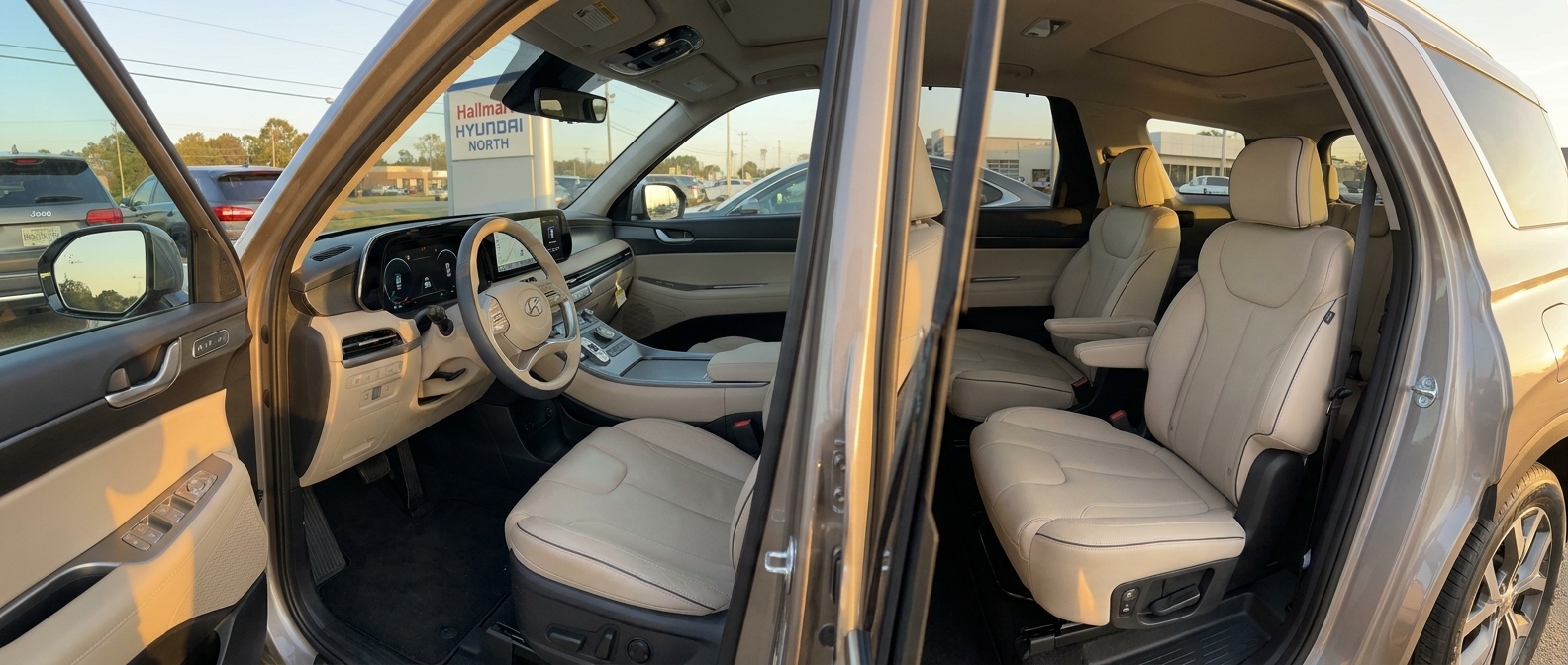
Mississippi October still runs warm, and a 45-minute I-55 commute will tell on a cabin that felt fine in the showroom. Run every seat test before you hit the road, and you'll thank yourself. Comfort impressions you form while parked rarely survive past the County Line Road overpass.
The 2026 Hyundai Palisade sits at one end of the comfort range we carry, with a Venue at the other. Both are real vehicles, built for genuinely different buyers. Our guide walks you through what to test, and in what order, so you'll leave knowing which model actually fits your drive.
Where Do You Start, and What Should You Test First?
Start before you ever turn the key, since a parked walkthrough hands you the baseline that every later road impression gets measured against, and skipping it means you're judging a cabin with nothing to compare it to once the road noise and seat fatigue set in. Don't buckle in and pull out of the lot. Give yourself five minutes parked before you ask us for the keys, and you'll catch seat and reach problems a quick loop would hide.
| What to Check | When to Do It | What to Look For | Insider Note |
|---|---|---|---|
| Seat adjust range | Parked, engine off | Full driver reach without strain | Find your natural position before road feel influences the impression |
| Ventilated seat cool-down | Parked, engine on, A/C on full | Feel airflow through seat material after 5-7 min | Ventilated seats pull cooled cabin air through the cushion; you must let the A/C cool the cabin first or the test tells you nothing |
| Rear-seat legroom | Parked, driver seat in your position | Knee clearance for your tallest passenger | Set the driver seat first, then climb in back |
| Cabin noise baseline | Engine idling, radio off | Engine bleed, HVAC fan roar, any rattle | Compare this impression again at highway speed |
| Second-row A/C vents | Parked, A/C running | Vent reach, strength, direction control | Critical for rear passengers on long summer runs to the Rez |
| Headroom all rows | Parked | Clearance with natural posture, not a slouch | Factor in whether a panoramic roof option reduces it |
Why run the parked walkthrough first? Because it builds a baseline, and without one your road impressions have nothing to measure against.
The Maneuvering and Fit Play
Once the parked checks are done, get the car moving on a route that mixes a surface street, an on-ramp, and a real stretch at highway speed, because comfort and noise don't behave the same at 65 mph as they do at idle. Here in the north metro, the I-55 on-ramp at County Line Road forces a genuine merge-speed test and then hands you highway cruising within 90 seconds.
The 2026 Hyundai Tucson and the 2026 Santa Fe land in the heart of the lineup we carry, so those two deserve close attention. Hyundai engineered the Tucson with acoustic-laminated glass and a multilink rear suspension to cut road noise, and at 65 mph with the radio off you're checking whether that noise competes with conversation. If it does, you've learned something. The Tucson's available front seats offer eight-way power adjustment with power lumbar support, and the rear seat provides roughly 41 inches of legroom, which sounds comfortable on paper and reads differently once your real passengers are back there during a drive.
The Santa Fe opens up more, with a second row at approximately 42.3 inches of legroom and shoulder room wide enough that three adults ride without constant elbow contact. If your weekends mean a full family load out to the Rez, you'll want to feel that extra dimension, not just read about it.
The Tucson's tighter footprint makes it easier to place in Madison-area parking and tighter school-line drop-offs, while the Santa Fe's extra room comes with a correspondingly wider parking-space requirement. Neither one is wrong. Only one matches your actual parking reality.
Insider Tip: The Ventilated Seat Test If you're evaluating a trim with ventilated front seats (SEL and above on the Tucson, and higher trims on the Santa Fe and Palisade), run the A/C on full for five full minutes before you press the ventilated seat button. The seat fan pulls cooled cabin air through the cushion, and it won't blow chilled air on its own. If the cabin is still hot from sitting on the lot, you won't feel meaningful airflow. Let the car cool down first, then switch the seat on, and you'll get a fair read.
Etiquette Note: Don't Rush the Back Seat Ask us to set the car up exactly as you'd configure it for ownership before you test row two or row three. If you drive with the seat all the way back and your teenagers ride behind you, we should slide it all the way back before the rear-seat test. A legroom check taken from the salesperson's driving position won't tell you anything useful about your real setup.
The 2026 Hyundai Palisade offers 44.2 inches of front legroom, 43.0 inches in the second row, and 32.1 inches in the third row, giving it among the most generous adult-ready cabin dimensions in the three-row class.
Go Enjoy the Drive: Your Pre-Decision Cabin Checklist
Work through every item on this list before you hand the keys back, because the friction that matters doesn't show up until fifteen or twenty minutes behind the wheel, not during a quick loop around the block. Every question here deserves an honest answer before the paperwork conversation starts.
- Driver seat support after 15-plus minutes: Does the cushion still feel supportive, or has pressure crept toward your tailbone? A ten-minute lot loop won't tell you. Ask for enough time to find out.
- Rear climate reach: Turn the second-row vents on and have your passenger report back. Do they feel real airflow? Can the vents redirect away from a rear-facing child seat?
- Cabin noise at highway speed: Radio off, A/C fan on low. Can you hold a normal conversation at 65 mph without raising your voice? You'll use that read on the I-55 run between Ridgeland and Canton.
- Third-row reality check (Palisade buyers): If your teenager already stands over six feet, the Palisade's third-row test isn't optional. Hyundai specs the third row at 32.1 inches of legroom. Confirm that number works for your family on a 45-minute return trip, not just a parking-lot sit.
- Lumbar hold on an on-ramp: On a brisk merge, does the seat hold your torso in place, or do you slide toward the door? Power lumbar and available seat bolstering exist for that reason.
- Infotainment reach without leaning: Seatbelt on, reach for the bottom edge of the touchscreen. If you have to pitch forward out of the seatback, that friction compounds over two weeks of daily driving.
- Liftgate and cargo floor: Pop the liftgate. If you're routinely loading gear for a day at the Reservoir, the liftover height matters more than the cubic-feet figure. A lower cargo floor edge makes a real difference by the hundredth load.
One thing we tell buyers straight. A car that's uncomfortable after 20 minutes is still the wrong car, no matter how good it looked on the lot.
Browse the current inventory at Hallmark Hyundai North before you come in, and you can tell us which trim you want to test. Getting the right trim on the drive is the most useful prep you'll make.
Categories:
Social


