


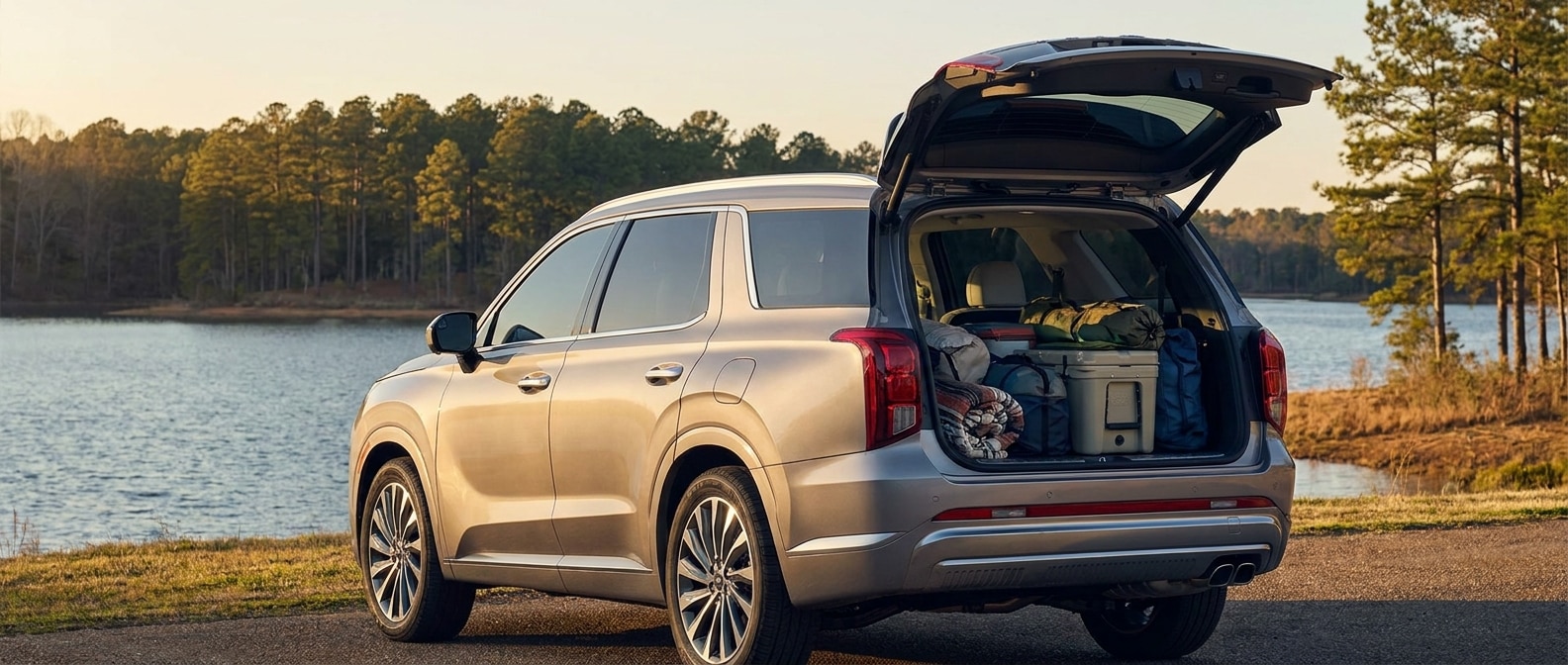
Start with the bottom line. The 2026 Hyundai Palisade can seat up to eight people and haul up to 86.7 cubic feet of cargo, but not both at the same time, and the trim you choose determines which one you're optimizing for. A fair question before you shop isn't whether there's enough room. The sharper one is how you configure this thing for what your life actually looks like. If you're loading up for a weekend at the Reservoir or a longer run down the Natchez Trace, the answer changes depending on which powertrain and seating layout you choose. We'll lay it all out with Hyundai's published figures so you can make the call before you get here.
Explore the 2026 Palisade on our lot
Will It Fit?
Yes, it fits, and the better question is how you slice it, because Hyundai lists the 2026 Palisade's cabin at 161.9 cubic feet of total passenger volume across three rows, a figure that says nothing about the cargo you give up to fill every seat or how the Hybrid shifts the rear-row math. The table below pulls every load-bearing dimension from Hyundai's specifications so you'll match your actual scenario to a real number.
| Load or Passenger Scenario | Dimension / Capacity | What You Get (and What You Give Up) |
|---|---|---|
| All 8 seats filled (bench second row, SE/SEL) | 161.9 cu ft passenger volume | 19.1 cu ft cargo behind 3rd row. Enough for a few carry-on bags, not a week of luggage |
| 7 seats filled (captain's chairs, SEL Premium/Limited/Calligraphy) | 161.9 cu ft passenger volume, 2nd-row gap between seats | Same 19.1 cu ft cargo; you trade the center seat for easier 3rd-row access |
| Third row folded, 5 passengers | 46.3 cu ft cargo (behind 2nd row) | Fits a double stroller, camp chairs, and a cooler, the Reservoir weekend sweet spot |
| All rear rows folded, driver + 1 | 86.7 cu ft cargo (behind front row) | Near-van capacity; a 4x8 sheet of plywood won't make it, but most flat-pack furniture will |
| 3rd-row legroom (all trims, V6) | 32.1 in | Adults fit for shorter hauls; on a Natchez Trace day-run that's manageable |
| 2nd-row legroom, V6 gas trims | 43.0 in | Full adult comfort, no compromise |
| 2nd-row legroom, Hybrid trims | 41.4 in | Down 1.6 in from the V6 due to hybrid battery placement, still comfortable, worth knowing |
| Front-row legroom | 44.2 in | No issue for any driver height |
| Towing, V6 (with tow prep package) | 5,000 lbs | Small boat, jet ski trailer, or enclosed cargo trailer fits the rating |
| Towing, Palisade Hybrid | 4,000 lbs | A smaller trailer or pop-up camper; the 1,000-lb difference matters if you own a heavier rig |
*Cargo and passenger dimensions per Hyundai specifications. Towing capacity requires proper equipment and configuration per Hyundai's towing guidelines.*
The 2026 Palisade's third row gives 32.1 inches of legroom. That's enough for adults on a day trip, but it's worth sitting back there yourself on the lot before committing if you run regular long hauls with a full house.
Loading It Right for Every Trip
Loading it right comes down to the fold sequence more than the raw numbers, so once you know the third row splits 60/40 and the bench second row folds per side, you've got a cargo lane for almost any run without turning the parking lot into a puzzle.
The third-row fold strategy:
- The third row splits 60/40, so you can fold one side to extend cargo length while keeping a passenger in the other seat
- This covers the run where you've got a kid in the back and you're also hauling something long from a hardware stop on Old Canton Road
- The second row on bench-seat trims (SE through SEL) folds independently per side too, giving you a 5-passenger setup with a longer cargo lane on one half
See the Palisade Hybrid's specs and availability
Check how the hands-free power liftgate (standard on most upper trims) behaves after a Reservoir afternoon with your arms full, and you'll see why it reads as essential equipment. It also clears properly in a standard parking space, worth confirming given the Palisade's 69.5-inch height and 199.2-inch length.
The Hybrid's second-row legroom can catch you off guard at 41.4 inches, about 1.6 inches less than the V6's 43.0 inches. That figure is Hyundai's own, and it traces back to the hybrid battery pack sitting partially under the passenger floor. For most adults on a day run to the Trace or a school-night carpool on I-55, you won't feel it. But if you're running eight passengers on a long drive regularly, the V6's additional rear-row space earns its keep.
Browse current Palisade inventory
Our team observation: On the V6, the sweet spot for a north-metro weekend run is the third-row-folded configuration. You open up 46.3 cubic feet, keep five full seats, and load the back without engineering it. That said, if you're pulling a boat or jet ski trailer out to the Reservoir, the V6's 5,000-lb tow rating is the one that matters. The Hybrid's 4,000-lb rating is solid, but a loaded pontoon boat with gear pushes that math past it in a hurry.
Before You Head to the Lot: Five Things to Confirm
Getting the configuration right starts well before the test drive, and the honest path is to settle five questions at the kitchen table first, so the trim and powertrain follow from how you'll actually use the seats.
- Count your regular passengers, not your maximum passengers. A family of five who occasionally runs seven people doesn't need to optimize the vehicle for seven. Know your baseline and build around it.
- Sit in the third row yourself. Hyundai puts third-row legroom at 32.1 inches. Whether that works for your specific passengers is a body-geometry question more than a spec-sheet one, and the lot visit settles it.
- Decide on the seating layout before the trim. Captain's chairs (7-seat) come on SEL Premium, Limited, and Calligraphy trims. If you need all eight seats, the SE and SEL bench-seat configuration is your lane. Don't assume upper trims hand you more seats.
- Check the tow requirement against your trailer. If your trailer is under 4,000 lbs loaded, either powertrain covers it, and the Hybrid's EPA-estimated 33 city / 35 highway / 34 combined mpg (FWD Blue SEL, EPA estimate) starts making the fuel math interesting on longer hauls. If it runs heavier, the V6's 5,000-lb rating and its EPA-estimated 19 city / 25 highway / 21 combined mpg (FWD, EPA estimate) is the call.
- Plan your cargo-loading sequence. If you load the back first and fill the cabin last, confirm that the Palisade's liftgate height and cargo floor work with what you typically haul. Large, flat items load easier with the second row down, and the cargo floor sits flat when both rows are folded.
The Call: Passenger Space, Cargo Space, or Both
The call comes out in the Palisade's favor on both counts, within one honest limit, because it won't force you to pick between people and cargo the way a smaller three-row does, yet it won't hand you 86.7 cubic feet and eight passengers in the same trip. Call it physics rather than a criticism.
For north-metro families whose weekends pull toward the Reservoir, the Natchez Trace, or the longer I-55 run up toward Canton, the configuration that works is usually the third-row-fold with five seats plus gear. You get 46.3 cubic feet there. That setup fits a weekend's luggage, beach chairs, a cooler, and room to spare. The eight-seat configuration is genuinely there when you need it, and you'll find the 19.1 cubic feet behind a full third row handles lighter loads fine.
The Palisade Hybrid adds the EPA-estimated efficiency advantage on that same route, meaningful on a 200-mile Trace run. The trade is 1,000 lbs of tow capacity and 1.6 inches of second-row legroom. If you don't tow anything heavy and your second-row passengers are smaller, the Hybrid's case gets straightforward fast.
We keep both the gas and Hybrid Palisade on our lot at Hallmark Hyundai North on Steed Road. Come sit in both, fold the seats, open the liftgate, and try the third row. You'll feel the difference the spec sheet can't show. The lot visit closes it.
Value Your Trade-In Before You Visit
Job Done
Hyundai's published figures for the 2026 Palisade confirm 19.1 cubic feet behind the third row, 46.3 with the third row folded, and 86.7 cubic feet maximum, with towing rated at 5,000 lbs (V6, properly equipped) or 4,000 lbs (Hybrid). Every number above is attributed to Hyundai specifications or EPA estimates. You won't find prices here, and none of these figures substitute for confirming your specific configuration against Hyundai's towing guidelines and your owner's manual.
Categories:
Social


