


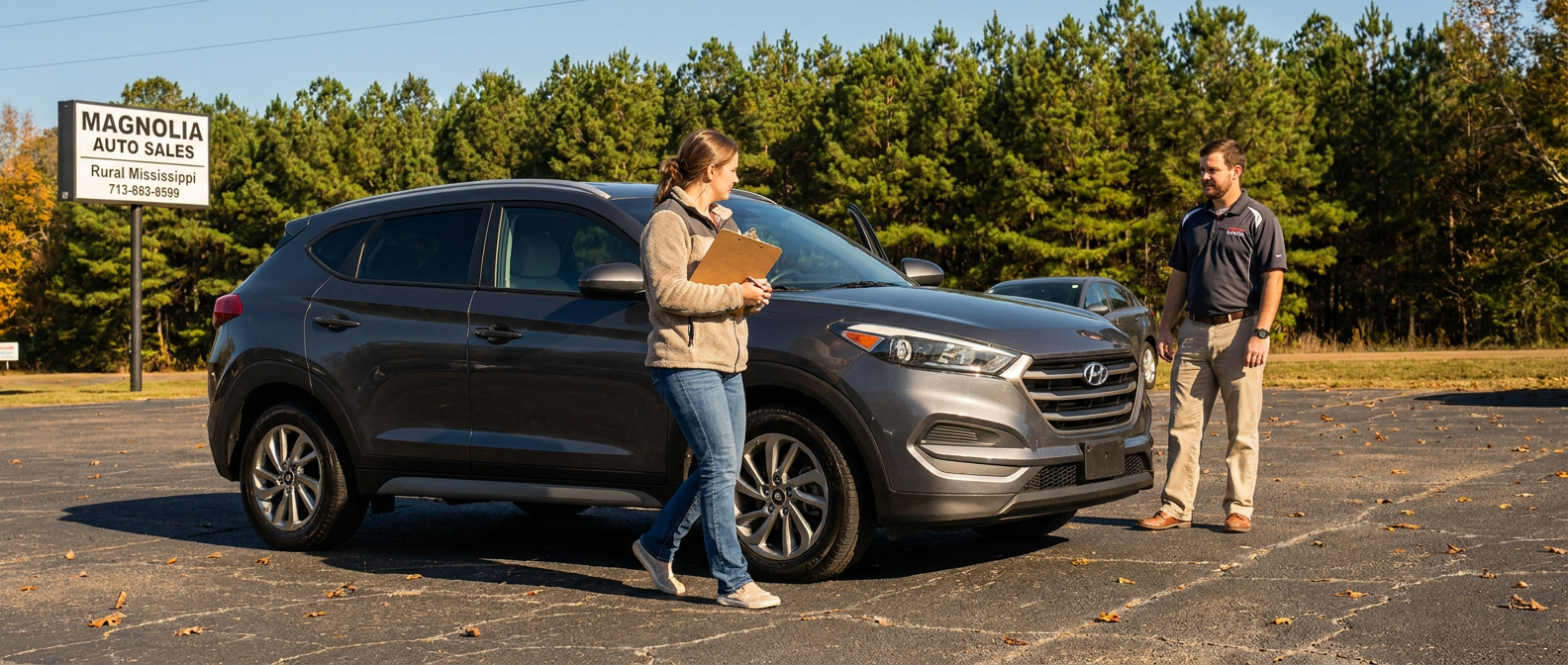
Buying a used Hyundai in the Jackson metro is a smart play. These models hold their value, the safety tech carries across even the mid-tier trims, and our pre-owned lot keeps a rotation of Hyundai models that gives you real options. A used car, though, is only as good as the inspection you run before you sign. Here's the checklist we lean on, built around what actually matters on these cars in our climate.
What Goes on the Checklist?
Work through these before you pull onto I-55 for the test drive. Print this page or screenshot it, and bring it along.
Before you start the engine
- [ ] Pull the 17-character VIN from the driver-side dashboard corner or the door jamb and run it at nhtsa.gov/recalls. It takes two minutes, costs nothing, and surfaces every open federal safety recall tied to that exact build.
- [ ] Confirm all four tires match in brand, size, and wear pattern. Mismatched tires on a Hyundai with a multi-link rear suspension (Sonata, Tucson, Santa Fe) are a flag worth asking about.
- [ ] Walk the body panels at a distance and then close up. Gaps that widen or narrow between hood, fenders, and doors suggest prior collision repair even when the history report comes back clean.
- [ ] Check all glass for cracks and look at the date codes in the corner. Replacement glass on a low-mileage vehicle invites a follow-up question.
- [ ] Crouch at each corner. The vehicle should sit level. A corner that rides noticeably lower points to a worn spring or strut.
- [ ] Under the hood, check engine oil on the dipstick, coolant level and color, and any oil residue around the valve cover or at the block seams. Dark, gritty oil means the maintenance schedule slipped. Milky coolant is a head-gasket conversation.
- [ ] Look for fluid stains on the pavement beneath the vehicle. A fresh puddle of water after an A/C run is normal condensate. Anything oily or green is not.
Cold start
- [ ] Let the engine start from cold if you can. Listen hard for the first 30 to 60 seconds, since a smooth idle is the target. A metallic knock that fades quickly is worth noting; one that doesn't fade is a reason to pause.
- [ ] Watch the instrument cluster as the engine catches. Warning lights should light up briefly and then go out. Any light that stays on, whether check-engine, oil pressure, ABS, or airbag, is a conversation before a purchase.
Cabin systems check (engine running, before you move)
- [ ] Turn the A/C to max cold and verify it pulls the temperature down within two to three minutes. In our climate, this is the check that matters most. A used Hyundai that spent its first years around here ran the compressor hard from May through September, so a weak system shows up on the lot before you ever drive off.
- [ ] Cycle the infotainment screen through every input, including radio, Bluetooth, navigation if equipped, and the backup camera. Some 2020-2021 Elantra and 2021 Tucson owners reported screen-blank events where the display goes dark and needs a full power cycle to restore. A quick run through all inputs surfaces a system that isn't fully stable.
- [ ] Test every power seat direction and confirm the seat locks in position.
- [ ] Run all windows up and down once. A window that hesitates or grinds gets worse in humidity.
- [ ] Confirm the heated and ventilated seats engage, if the car has them.
The drive itself
- [ ] Find a straight, flat road and release the steering wheel briefly at moderate speed. A pull in either direction points to alignment or suspension wear.
- [ ] Accelerate firmly from a stop through the first two or three gear shifts. The transmission should feel smooth with no hesitation, flare, or hard clunk.
- [ ] Brake hard from highway speed in a safe spot with no traffic behind you. The pedal should feel consistent and stable, with no sponginess. Any vibration through the pedal points to warped rotors.
- [ ] On a surface street or parking lot, turn the wheel near lock-to-lock at low speed and listen for clicking from the front. A single faint click at full lock on a front-wheel-drive Hyundai is noted in service literature as a characteristic. Repeated clicking or a grinding sound is a different matter.
- [ ] Drive over a rough patch or a speed bump and listen beneath the car. Suspension should absorb it without knocking or creaking.
- [ ] If the vehicle has a sunroof, run it open and closed once and check the drain channel edges for water staining on the headliner above the doors.
Why These Items Are the Ones That Matter
None of the items above are arbitrary, and a handful of them come straight from documented patterns in the Hyundai recall and complaint record. Knowing the why behind each one makes you a sharper buyer.
The VIN recall check. Per NHTSA, recall repairs at an authorized Hyundai dealer are performed at no charge regardless of current ownership. So the question isn't whether repairs are covered. It's whether the repair already happened on this specific vehicle. Some recalls apply to exact production batches within a model year, so a year-and-model search isn't the same as a VIN search. Notable documented campaigns include a 2019-2020 Elantra and 2019-2021 Kona issue (NHTSA campaign 21V301000) involving a piston oil-ring heat treatment defect in the 2.0L Nu MPI engine that can lead to oil consumption and engine damage, and a 2020-2023 Sonata fuel system issue (NHTSA campaign 25V796000) involving a check valve that can allow fuel tank expansion and contact with hot exhaust components. Both campaigns have dealer remedies, but "remedy available" and "remedy performed on this VIN" are two different answers.
The A/C check. This one's about the market, not the model. A Hyundai that commuted the I-55 corridor between Ridgeland and Madison through five summers ran its compressor under load in 90-degree heat, stop-and-go, for months at a stretch. An A/C system that tests weak on the lot in October tells you plenty about how that car lived in July (the month that tests every compressor around here).
The transmission feel. The I-55 and I-220 interchange runs stop-and-go through commute hours. A used vehicle that spent its working life here piled up more low-speed clutch pack cycles than one that covered the same mileage on open highway. Accelerate hard through the gears during your drive, since you're not checking ride quality so much as whether the automatic shifts cleanly under load, the way it has to every morning on the way into town.
The infotainment screen. Consumer Reports owner data flags screen-blank events across both the 2020 Elantra and 2021 Tucson. The screen doesn't fail catastrophically. It just goes dark and needs a power cycle to come back. Run through all inputs before you drive, so you're not finding out at 65 mph on the interstate.
The Tucson ranks among the stronger used buys in the lineup for a Madison-area shopper who wants a compact SUV with genuine rear legroom, and it holds up on the highway beautifully. That said, we've seen plenty of used Tucson examples where the infotainment was the lone rough edge, so we flag it on purpose here.
Team note: The maintenance history printout tells you more than the odometer does. A 90,000-mile Hyundai with consistent service records is often a better buy than a 60,000-mile one with a gap between 30,000 and 55,000 miles and no record of what happened in between. Ask for it. If the seller can't produce one, that's information too.
Item / Why It Matters
| Item | Why It Matters for a Used Hyundai in This Market |
|---|---|
| VIN recall check at nhtsa.gov/recalls | Some campaigns (engine, fuel system, airbag) are VIN-specific; a model-year search misses build-date variations |
| Cold-start knock check | The 2.0L Nu MPI engine in certain 2019-2021 Hyundais had a documented oil-ring defect; a knock that doesn't fade warrants investigation |
| A/C max-cold test on the lot | Five-month Mississippi summers run Hyundai compressors hard; a weak system on a cool October day was likely failing in July |
| Infotainment screen cycle | Screen-blank events reported on 2020 Elantra and 2021 Tucson; surface instability before the drive |
| Transmission shift feel under load | Stop-and-go I-55 commuting accelerates clutch pack wear; a clean firm shift under acceleration is the baseline |
| Carpet and padding under the floor mat | Mississippi flooding events can saturate padding long after the carpet surface dries; stiff or stained padding is a flood indicator |
| Maintenance records | Service gaps are a stronger red flag than mileage alone on these engines |
Your Print-and-Go Summary
Walk up to the car with these six questions already answered on your phone. Everything else flows from them.
- VIN recall status. Checked at nhtsa.gov/recalls before you drove a single mile.
- Cold-start sound. Engine settled smoothly into idle with no persistent knock.
- A/C cold pull. Cabin temperature dropped to cold within two to three minutes of max setting.
- Warning lights. All cleared normally after startup.
- Transmission shifts. Clean and firm through the first two to three gears under real acceleration.
- Service records in hand. Mileage intervals account for, no unexplained gaps.
If the car clears all six, you're in a position to talk seriously. If it fails any one of them, you've got a specific, documented reason to either walk or negotiate before the paperwork opens. Either way, you're not guessing.
When you're ready to dig into the financing conversation, our team can walk you through the options without any pressure on the timeline.
Schedule a Pre-Purchase Inspection
Frequently Asked Questions
Does a Hyundai dealership have to fix an open recall on a used car I bring in?
Yes. Per NHTSA federal regulation, recall repairs are performed at no charge at an authorized Hyundai dealer regardless of whether you're the original owner. If you purchase a used Hyundai with an open recall, you can bring it to our service department and the remedy is covered at no cost to you. The fastest way to confirm whether a specific recall applies to your vehicle is to run the 17-character VIN at nhtsa.gov/recalls before or after purchase.
How long should a used-car test drive actually be?
Long enough to include a full highway acceleration run, at least one firm brake from speed, and a stretch of surface-street driving with stops. That typically means 20 minutes at a minimum. A short lot loop at low speed won't surface transmission hesitation, brake pedal feel under load, or the suspension behavior you'd experience on the I-55 ramp from County Line Road. If a seller is reluctant to allow a full drive, treat that reluctance as data.
Categories:
Social


