


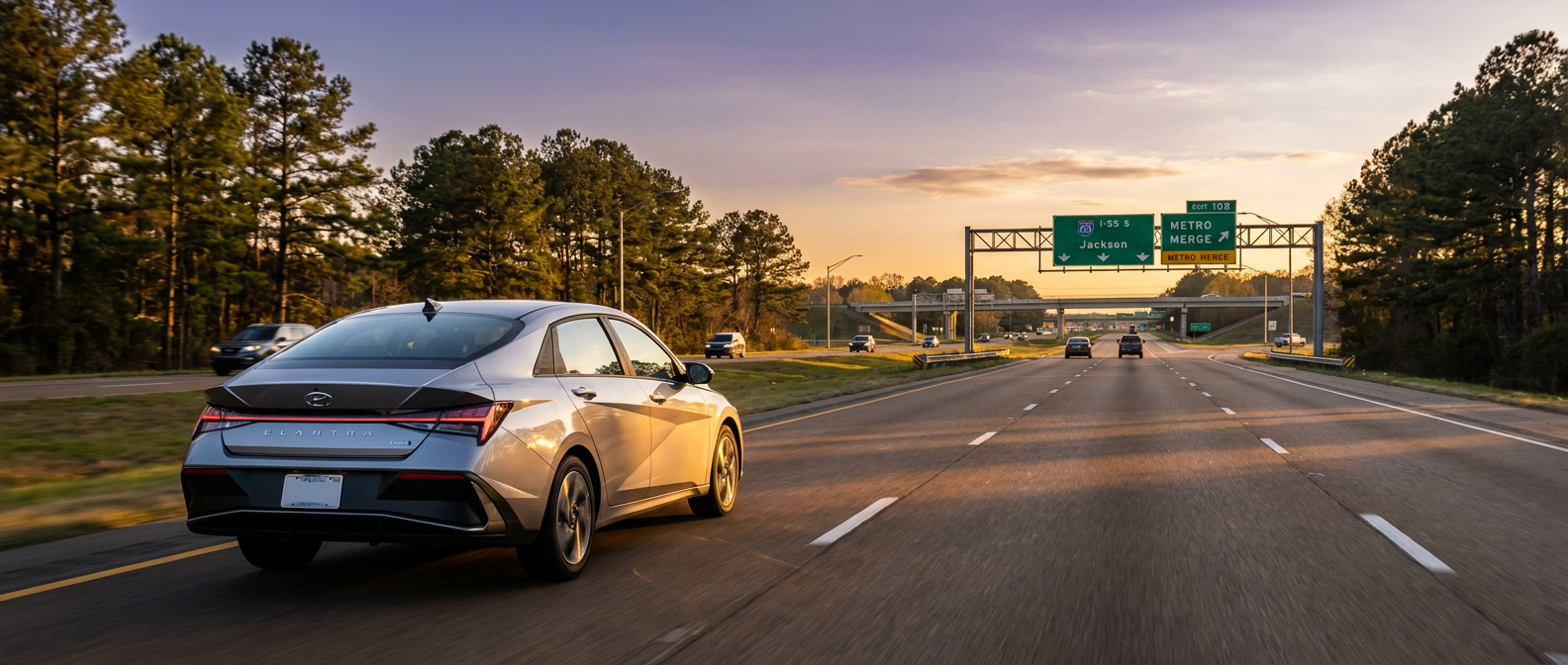
The Elantra Hybrid is our pick for this commute. We'll walk through why, and we'll be straight about the two cases where a different model makes more sense on the same route.
The Ridgeland-to-Florence corridor runs about 22 miles each way, and it isn't a pure highway cruise. You start on I-55 through the Ridgeland interchange, then thread through the southern edge of Jackson before dropping onto US-49 South into Rankin County. That mix of suburban interstate and Jackson merge traffic rewards a hybrid powertrain differently than a straight freeway run would. It also means you're running the air conditioning hard through Mississippi's long, humid summers, which raises the stakes on interior comfort. Each of the four models below has a legitimate reason to be here. Only one of them earns the top spot.
Our Ranking: Which Hyundai Fits the Ridgeland-Florence Route
| Rank | Model | Best For | Standout Spec |
|---|---|---|---|
| 1 | Elantra Hybrid | Solo or paired daily commuters who fill up twice a month | EPA-estimated 54 mpg combined (Blue trim) |
| 2 | Sonata Hybrid | Families or anyone who wants midsize space with near-matching efficiency | EPA-estimated 51 mpg combined (Blue trim) |
| 3 | Tucson Hybrid | Commuters who also haul gear on weekends or want AWD confidence | EPA-estimated 38 mpg combined; AWD standard |
| 4 | Venue | Solo commuters on a tighter budget who park in tight spots on both ends | EPA-estimated 31 mpg combined |
Elantra Hybrid: The Efficiency Argument Is Settled
The 2026 Elantra Hybrid earns an EPA-estimated 54 mpg combined in its Blue trim (51 city / 58 highway). That number matters on this run because the Jackson metro stretch generates real stop-and-go, and hybrids claw back energy through regenerative braking in exactly that scenario. The highway legs on I-55 and US-49 play to its highway figure. At 54 mpg combined, you're looking at about 594 miles of estimated range per tank, enough to cover this commute roughly 13 times on a single fill-up.
One tradeoff is real. The Elantra Hybrid is a sedan, and its trunk gives you 14 cubic feet of space, fine for briefcases and dry-cleaning but short for a weekend of soccer gear or a cooler run to the Reservoir. If your car has a second job on Friday afternoon, scroll down. If it's a commuter first, this is the one.
The 1.6-liter hybrid powertrain produces 139 horsepower, enough for the I-55 on-ramp merge from the Ridgeland area but no thrill for anyone used to a turbocharged feel. Cabin temperature management is a genuine comfort win on Mississippi summer afternoons, helped in part by Hyundai's ventilated seat options on upper trims, and that's a real quality-of-life detail on a daily 22-mile run in July.
Sonata Hybrid: Midsize Comfort at Near-Identical Efficiency
The 2026 Sonata Hybrid Blue trim earns an EPA-estimated 51 mpg combined (47 city / 56 highway). Three fewer mpg than the Elantra Hybrid on paper. Over 10,000 miles of annual commuting, that gap is real but modest. What you gain is a noticeably larger cabin, a 2.0-liter hybrid system producing 192 combined horsepower, and a 13.2-gallon fuel tank that pushes theoretical range toward 670 miles at the combined EPA estimate.
Households where two adults share the commute, or where someone needs genuine rear legroom on longer drives, are the fit here. The Sonata Hybrid's highway figure (56 mpg in Blue trim) actually surpasses most competing midsize hybrids on the straight US-49 stretch south of Jackson.
Name the tradeoff plainly. The Sonata Hybrid is front-wheel drive only across all trims. For a flat Mississippi commute like this one, that's rarely a practical issue. But it's worth knowing going in.
Tucson Hybrid: When the Commuter Car Doubles as a Weekend Vehicle
The 2026 Tucson Hybrid comes in at an EPA-estimated 38 mpg combined and brings something neither sedan on this list offers, standard all-wheel drive across every trim. It also has 8.3 inches of ground clearance and a 232-horsepower turbo hybrid powertrain that feels meaningfully quicker on the I-220 interchange than either sedan above.
Thirty-eight combined mpg is still a strong number for an AWD compact SUV. The plain context is that it runs about 30 percent lower efficiency than the Elantra Hybrid. If you drive 10,000 miles a year on this commute, that difference adds up over multiple fill-ups annually. Worth it if your car also hauls camping gear toward the Natchez Trace on weekends. Not the choice if the commute is genuinely the only job.
The practical win here is cargo flexibility. The Tucson Hybrid gives you substantially more cargo room than either sedan, with fold-flat rear seats that change the equation for weekend utility completely.
Buying caution: Before choosing between the Tucson Hybrid and the Sonata Hybrid on efficiency grounds, check your actual annual mileage on this corridor. A round trip to Florence is about 44 miles. Five days a week, 50 weeks a year, that's roughly 11,000 commute miles. The difference between 38 and 51 mpg combined is meaningful over that distance. Run the numbers for your own situation rather than assuming either is obviously right.
On the Ridgeland-to-Florence run specifically, the Elantra Hybrid Blue trim's EPA-estimated 54 mpg combined means a theoretical ~594-mile range, enough for about two weeks of daily 44-mile round trips on a single tank.
Venue: The Honest Case for the Smallest Option
If you're a solo commuter, you park in tight spots at both ends of this run, and the weekend life doesn't demand cargo capacity, the 2026 Venue earns genuine consideration. Its EPA-estimated 31 mpg combined (29 city / 33 highway) is lower than anything else on this list, but its footprint (159 inches overall length) makes it easy to navigate the Ridgeland-area surface streets and the tighter Rankin County side streets around Florence.
The Venue's 18.7 cubic feet of cargo space behind the rear seats is the smallest number on this list. Fold the rear bench and it grows to 31.9 cubic feet, which handles everyday errands without strain. It runs a naturally aspirated 1.6-liter engine with 121 horsepower. Plenty for this specific commute. It's not the choice for anyone who needs to merge assertively onto a fast I-55 ramp with a full car.
What the Venue does well is keep this commute simple and well-equipped without unnecessary complexity. Wireless Apple CarPlay and Android Auto come standard. The smaller fuel tank (11.9 gallons) gives a range of about 369 miles at the combined EPA estimate, which means more frequent fill-ups than any hybrid option above. That's the tradeoff you accept for the smaller footprint.
Categories:
Social


