


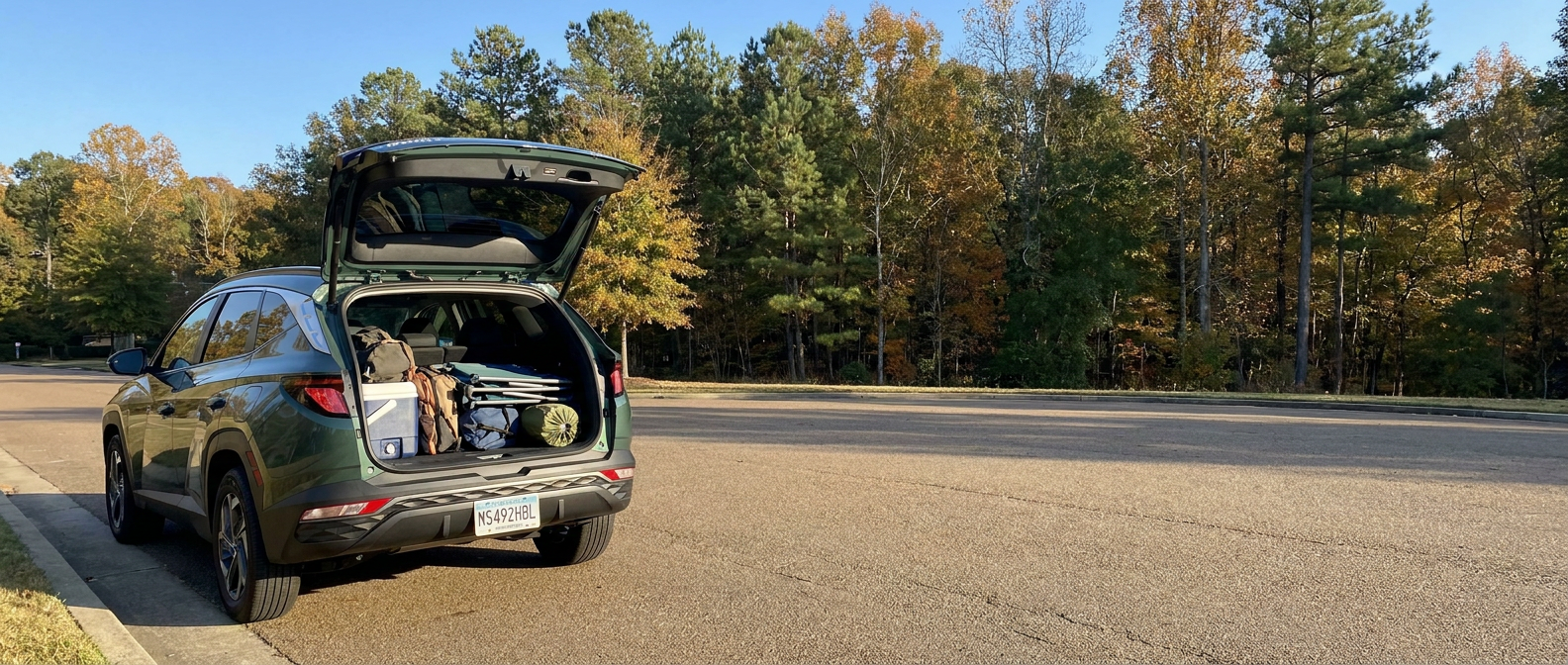
A belief runs through almost every SUV shopping conversation in this market. Go bigger, get more cargo. It sounds logical, and it still steers real buyers to the wrong model.
The 2026 Tucson is a compact two-row crossover, and it delivers more maximum cargo volume than the three-row Santa Fe. Hyundai publishes that number, so it isn't a sales pitch, and it shifts the math on plenty of purchase decisions. We've walked enough buyers through this on the lot to know the myths travel faster than the specs. So let's fix that.
The short version
- Bigger Hyundai does NOT automatically mean more cargo: the 2026 Tucson maxes at 80.3 cu ft, edging the three-row Santa Fe's 79.6 cu ft max.
- The Kona's "tiny trunk" reputation is based on a pre-2024 model. The 2026 Kona carries 25.5 cu ft with seats up and 63.7 cu ft folded, a completely different vehicle.
- A hybrid battery does NOT reduce cargo space in the Tucson HEV or Palisade. The Tucson Plug-In Hybrid is the exception.
- The 2026 Palisade's 19.1 cu ft behind the third row is real, usable space. Equivalent to the Venue's entire cargo hold.
- The seats-up figure is the one that matches your daily life. Max capacity is what you get twice a year.
Browse the 2026 Hyundai Tucson at Hallmark Hyundai North
Are the Most Common Hyundai Cargo Claims Actually True?
Some of these hold up and some fall apart the moment you read a spec sheet, so we've set the claims we hear on the lot against Hyundai's own published figures, and every reality column below comes straight from those numbers instead of from whatever sounds right at first. We've put them side by side here.
| The Claim | What's Actually True | Source |
|---|---|---|
| "The bigger the Hyundai, the more cargo room" | The 2026 Tucson (compact, two-row) maxes at 80.3 cu ft. The three-row Santa Fe maxes at 79.6 cu ft. Size order and cargo order are not the same. | Hyundai published specs |
| "The Kona trunk is too small to be useful" | Pre-2024 Kona carried roughly 19 cu ft. The 2026 model carries 25.5 cu ft with seats up and 63.7 cu ft folded flat. That is a full class jump, not a minor update. | Hyundai spec / Edmunds verified |
| "A Hyundai hybrid battery eats your cargo space" | The 2026 Tucson HEV and Palisade match their gas counterparts exactly in cargo volume. The Tucson Plug-In Hybrid (PHEV) is the exception: its larger battery sits under the floor and does reduce space. | Hyundai published specs |
| "The Palisade has no real cargo with the third row up" | Hyundai rates the 2026 Palisade at 19.1 cu ft behind the third row. That is the same figure as the Venue's full cargo hold. Not a dealbreaker for a family's daily routine. | Hyundai published specs |
| "The Venue is too small to haul anything" | At 31.9 cu ft with the rear bench folded flat, the Venue handles everyday errands, a grocery run, or luggage for two. It is genuinely limited for large or bulky gear. That is the honest line. | Hyundai published specs |
What the Seats-Up Number Tells You That Maximum Capacity Never Will
The seats-up number tells you how the cargo area performs on an ordinary Tuesday, while maximum capacity only shows up when you fold everything flat for the few big hauls a year, so the two figures end up answering completely different questions about how you load a vehicle. Most comparisons still lead with the maximum. All seats folded, everything flat. It photographs well. You'll reach for that setup a few times a year.
The figure that matches your actual life is seats up, meaning real passengers in back, the hatch closed, and the cargo area doing its daily job. That's where the lineup separates in ways the brochure keeps quiet.
Here's where it shows up: Hyundai lists the 2026 Tucson, gas and HEV alike, at 41.2 cu ft behind the rear seats. It comes in above what the three-row Santa Fe manages with its second row folded and third row up, which Hyundai puts at 40.5 cu ft. Seat five people in a Santa Fe and you've got less working cargo room than a Tucson owner hauling the same load. The third row eats into the space from one end while the passengers fill it from the other.
The 2026 Palisade reads modest behind the third row at 19.1 cu ft. It still runs larger than the Venue's full cargo hold.
It'll fit backpacks, a grocery haul, or a weekend bag for a run out along the Natchez Trace Parkway (no folding or shuffling required). Fold the third row and you jump to 46.3 cu ft. Flatten everything and Hyundai publishes 86.7 cu ft, the largest number in the lineup by a wide margin.
See the 2026 Palisade at Hallmark Hyundai North Explore the 2026 Santa Fe
Here's the full 2026 lineup on the figure that matters. The seats-up column is the one to read first.
| Model | Cargo (Seats Up) | Max Cargo (Seats Folded) | Rows |
|---|---|---|---|
| 2026 Venue | 18.7 cu ft | 31.9 cu ft | 2-row |
| 2026 Kona | 25.5 cu ft | 63.7 cu ft | 2-row |
| 2026 Tucson (gas/HEV) | 41.2 cu ft | 80.3 cu ft | 2-row |
| 2026 Santa Fe | 14.6 cu ft (3rd row up) | 79.6 cu ft | 3-row |
| 2026 Palisade | 19.1 cu ft (3rd row up) | 86.7 cu ft | 3-row |
The 2026 Tucson's seats-up cargo of 41.2 cu ft exceeds the Santa Fe's third-row-up figure by nearly three times, and its maximum cargo of 80.3 cu ft edges the Santa Fe's 79.6 cu ft max. The compact two-row outhauls the midsize three-row in almost every real-world loading configuration.
Measurement note: Hyundai publishes the Tucson's cargo volume two ways. The 41.2 cu ft figure uses Hyundai's internal method, while the SAE-standard figure comes in at 38.7 cu ft. Both describe the same physical cargo area, just measured under different protocols. The load floor, the hatch opening width, and the liftover height don't change between the two. Your best move is to open the hatch in person, and we're happy to do that any time.
So What Should You Actually Check Before You Sign?
Before you sign, check three things a spec table never shows, because a big cubic-foot number can still sit behind an awkward load floor, and the right configuration for your family depends on how your seats actually sit day to day rather than on the single largest figure in a brochure. We walk every buyer through these on the lot.
The liftover height and opening width. A big cubic-foot number means little if loading the cargo area feels awkward. The Tucson's wide rear opening and low liftover height make it easy to slide in gear from the Rez, a kayak bag, a cooler, or a stroller without a shoulder workout. Santa Fe buyers get a hands-free power liftgate as standard, and it earns its keep. Put your hands on both before you decide.
The underfloor storage and tie-down points. The 2026 Tucson's cargo area includes a dual-level floor with six standard tie-down anchors. An underfloor tray keeps a rain cover, a charger cable, or a roadside kit out of your main cargo space without stealing an inch of it. The Santa Fe carries an underfloor storage tray too. None of this shows up in cubic-foot comparisons, and it changes how the space lives.
The configuration you'll actually run day to day. If you're loading up for a weekend at the Ross Barnett Reservoir with two adults and a full hatch of gear, the Tucson with seats folded is a capable, practical choice. If three rows of family is your baseline, and the third row stays up on school pickups and game days, then the Palisade's 19.1 cu ft is the number your life fits into. Work out which scenario is yours before anything else.
One tradeoff is worth stating plainly. The Santa Fe's 14.6 cu ft behind the third row is real, usable space for light daily loads. It handles book bags and a grocery stop. It isn't enough for a fully occupied three-row family hauling gear for a weekend. The Palisade's 19.1 cu ft buys meaningful breathing room, and that gap is worth understanding before you choose between them.
See What Your Current Vehicle Is Worth
View Our Full 2026 Hyundai Inventory in Ridgeland
Don't shop by model size alone. Shop by the seats-up figure that matches how you load the vehicle day to day. When you're ready to open some hatches and see it in person, we're at 450 Steed Rd in Ridgeland, and we'll show you every configuration you're weighing.
Frequently Asked Questions
Does the 2026 Hyundai Tucson have more cargo space than the Santa Fe?
In most real-world configurations, yes. With all seats occupied, the Tucson provides 41.2 cu ft of cargo room behind the rear seats versus the Santa Fe's 14.6 cu ft behind its third row. With seats folded flat, the Tucson maxes at 80.3 cu ft and the Santa Fe at 79.6 cu ft, so the compact two-row outhauls the midsize three-row even at maximum capacity. The one scenario where the Santa Fe gains ground is running five or fewer passengers with its third row folded and second row in use, where it delivers 40.5 cu ft versus the Tucson's fully folded 80.3 cu ft. For everyday loads with passengers in back, the Tucson is the more cargo-capable vehicle.
Does the 2026 Hyundai Tucson Hybrid have less cargo space than the gas model?
No. Hyundai publishes identical cargo figures for the 2026 Tucson gas and the Tucson Hybrid: 41.2 cu ft behind the rear seats and 80.3 cu ft at maximum with seats folded. The hybrid battery is packaged efficiently under the rear seats and does not reduce the usable cargo area. The Tucson Plug-In Hybrid is different. Its larger plug-in battery does reduce cargo volume, so if that specific powertrain is on your list and cargo space is a priority, compare that configuration directly before deciding.
Categories:
Social


