


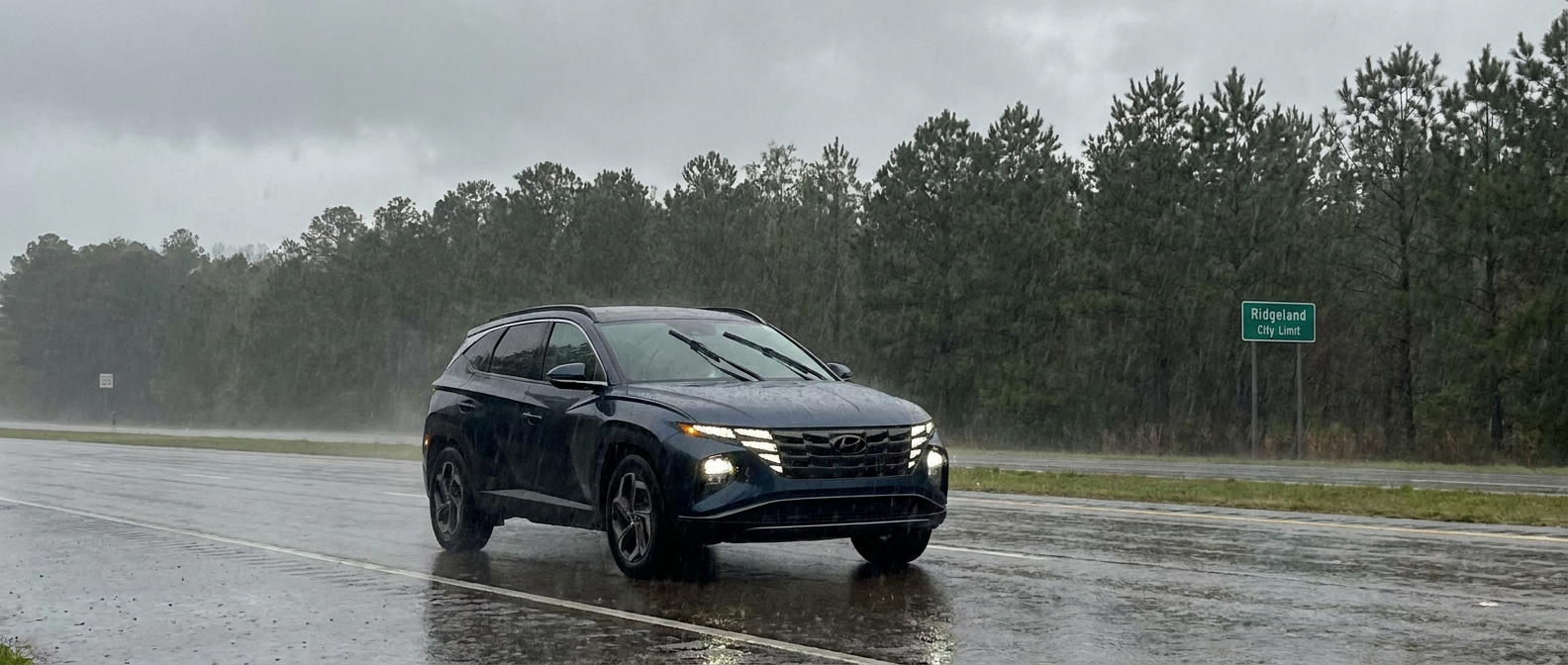
Ridgeland averages about 54 inches of rain a year and roughly 104 days of measurable precipitation, so there's no real dry season here. When an afternoon thunderstorm drops an inch in forty minutes on I-55 at the I-220 interchange, visibility is the whole game. Here's what your Hyundai actually does about it, and which trim-level decisions carry more weight than they look like they do before you sign.
The 2026 Hyundai Tucson sits at the middle of the lineup and illustrates the choices most clearly, so it's a good place to start.
Does Your Trim Actually Have Rain-Sensing Wipers?
Not every Hyundai comes with rain-sensing wipers, and it's a fair thing to confirm at Hallmark Hyundai North before the first hard rain catches you. Only the upper trims include it, so a Kona or a base Tucson flips to 'Auto' and nothing adjusts on its own. The lower trims still give you a capable manual intermittent, just not the automatic kind.
Picture it on the Natchez Trace Parkway. You hit the first hard rain, flip the wiper stalk to 'Auto,' and the blades keep their last setting. The assumption that rain-sensing comes standard is an easy one to make, because Hyundai packages it as a premium feature and the spec sheet doesn't always make the tier break obvious.
The table below maps where rain-sensing lands across the 2026 models we carry.
| 2026 Model | Trims WITHOUT Rain-Sensing | Trims WITH Rain-Sensing | What Lower Trims Have |
|---|---|---|---|
| Tucson | SE, SEL, XRT | Limited | 2-speed variable intermittent (manual) |
| Santa Fe | SE, SEL, XRT | Limited, Limited Hybrid | 2-speed variable intermittent (manual) |
| Palisade | SE, SEL, SEL Convenience, XRT PRO | Limited, Calligraphy | 2-speed variable intermittent (manual) |
| Palisade Hybrid | SE, SEL, SEL Convenience | Calligraphy | 2-speed variable intermittent (manual) |
| Sonata Hybrid | Blue, SEL | Limited Hybrid | 2-speed variable intermittent (manual) |
| Kona | All US trims | Not available in the US | 2-speed variable intermittent (manual) |
The system runs off an optical sensor mounted at the top of the windshield. According to Hyundai's own service documentation, that sensor fires LED light at the interior surface of the glass. When the glass is dry, almost all of that light reflects cleanly back to a photodiode receiver, so the system knows it's clear. Rain on the outside surface scatters the light and drops the reflected brightness. The system reads that loss, calculates rainfall intensity, and adjusts wiper speed and interval in real time. Once the rain stops, reflected brightness returns to baseline and the wipers stop on their own.
On light drizzle, the practical gap between rain-sensing and a well-set manual intermittent is smaller than the marketing implies. It becomes real when intensity is changing fast. Think of the kind of squall that goes from mist to downpour in sixty seconds heading north on I-55. Rain-sensing tracks that change continuously. Manual intermittent keeps doing what you last set it to.
The Maneuvering and Systems Play
Every 2026 Hyundai we sell ships with Hyundai SmartSense standard across all trims, so the core safety net doesn't hinge on which model you pick. No exceptions. Forward Collision-Avoidance Assist, Lane Keeping Assist, Blind-Spot Collision-Avoidance Assist, Automatic Emergency Braking, and Electronic Stability Control come in every car regardless of trim level or whether it has rain-sensing wipers.
The 2026 Palisade and the IONIQ 5 both show up in Hyundai's OEM parts documentation as carrying rain sensor pads in the 2026 model year. One detail for Palisade buyers to keep in mind. Most trims sit at 7.4 inches of ground clearance (the XRT PRO reaches 8.4 inches), which handles normal managed-road puddle depths comfortably. Flash flooding is a different animal, and no clearance figure addresses it.
In heavy rain, camera-based safety features come with a real caveat. Lane Keeping Assist and Forward Collision cameras work best when the windshield's clean and lane markings show through the spray. Heavy downpour or standing water over painted lines cuts their effectiveness. Radar-based features, Blind-Spot Collision-Avoidance in particular, hold up far better because radar punches through spray where cameras can't.
ABS and Electronic Stability Control stay active no matter what any sensor can or cannot see. They don't depend on visibility.
Across every trim, the 2026 Santa Fe carries acoustically-laminated windshield glass as standard, which Hyundai publishes in its specifications. The lamination layer trims wind noise, and it matters in a Mississippi rainstorm because the roar of a hard cell can mask sounds you'd otherwise catch. Automatic High-Beam Assist, part of SmartSense, manages headlights in low-visibility evening rain. It drops to low beam when it spots oncoming traffic and returns to high once the path clears. On the Natchez Trace at dusk in a rain event, that behavior earns its keep.
Insider parking tip for wiper arm position: Most 2026 Hyundais, including the Tucson, Palisade, and Sonata, park their wiper arms below the hood line. After a hard rain or a summer wash, the blade can settle into pooled water on the hood surface. Before your next wet run, pull the arm gently off the glass and let it snap back. You're checking that the edge contact is clean and even. Our service team sees smear patterns on summer-cooked blades when cars roll in after the first serious fall rains.
Sensor lens maintenance: Rain-sensing wipers depend on a clean sensor pad where the optical sensor meets the windshield interior. Road film, wax overspray from a detail, or bug residue in that small upper-windshield zone can cut sensitivity or trigger erratic wiping. If your auto wipers start acting up after a road trip or a full-service detail, check that spot first with a clean microfiber and glass cleaner. It takes thirty seconds.
Next step: If your blades are smearing, the auto sensitivity's off, or you want a lens check on the SmartSense camera before the winter rains settle in, our service team can handle all three in a single visit.
Before the Next Storm: Your Hyundai Visibility Checklist
Mississippi's rain doesn't hand you a warning season, so a quick visibility check pays off in any month, not just the depths of winter. October in Ridgeland still averages over 3 inches, and the Natchez Trace Parkway through Madison County runs unlit, which matters the moment visibility drops. Run through this list before the next serious rain day.
- Wiper blade condition. The rubber edge should stay supple, not cracked or glazed. A half-moon streak in the center of the wipe arc points to uneven pressure. Mississippi summers break down rubber through UV and heat faster than mileage alone does.
- Washer fluid level. I-55 spray on a rain commute is thick with tire particulate. You'll burn through more fluid on one wet trip than in two dry weeks. Top it off before the storms come back.
- Headlight aim. Mississippi law requires headlights on whenever your wipers are running. LED headlights on current Hyundai models throw a wider, whiter beam than older halogen units. On an older model, downward-aimed headlights kick glare off the wet road surface right in front of you.
- SmartSense camera lens. The forward-facing camera sits at the top center of the windshield, behind the rearview mirror. Road film builds up there. A clean interior surface at that point keeps Lane Keeping Assist and Forward Collision-Avoidance reading clearly.
- Tire tread depth. Per NHTSA's published guidance, wet-road stopping distances climb sharply as tread depth drops below 4/32 of an inch. At the legal minimum of 2/32, wet-road braking distance runs significantly longer than at new-tire depth. Use a quarter. If you can see all of Washington's head above the tread groove, you're near 4/32, so don't wait for 2/32 in a market that sees rain year-round.
- Know your always-on systems. ABS and Electronic Stability Control work regardless of camera or sensor visibility. In a slide or a hard-brake moment on wet pavement, they kick in without any input from you. Keep steady brake pressure and let the system pulse the way it's built to.
The service team at Hallmark Hyundai North can cover blades, washer fluid, camera lens, and a quick tire tread check in a single service visit. Worth doing before the winter weather pattern arrives.
Categories:
Social


