


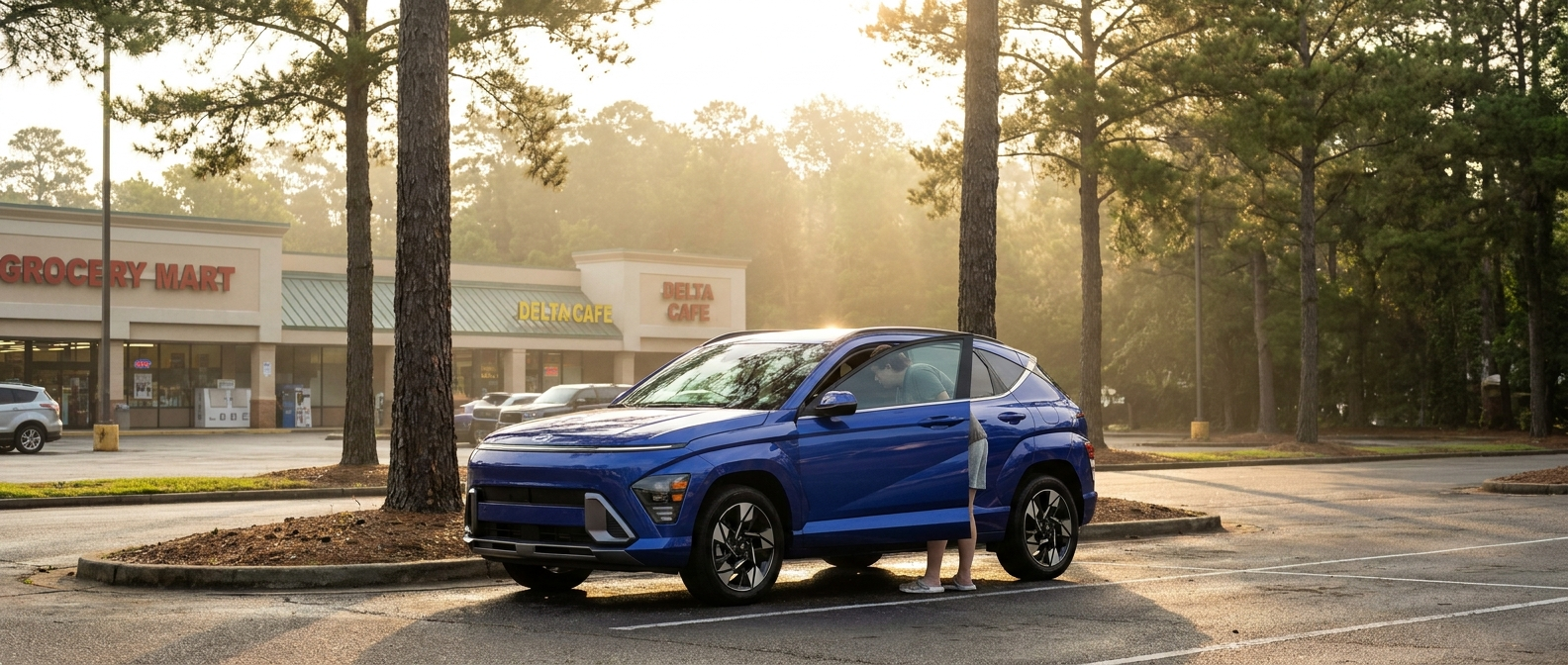
You're not planning a road trip. You need a car that handles the Ridgeland Target run, the Canton Road Kroger loop, the school pickup, the pharmacy drive-through, and the occasional haul over to Clinton without making you nervous about what's lurking in the NHTSA database. That's a completely different question than "which Hyundai looks nice," and it deserves a completely different answer.
Three Hyundai models fit exactly this kind of life, the Venue, the Kona, and the Tucson. The right model year matters more than the badge on the back, and that goes double on the used market. Here's what the data actually shows.
The short version
- Venue sweet spot: 2022-2023. Lowest NHTSA complaint density in the model's history; the 2020-2021 cars carry a documented seat belt pretensioner recall (22V458000) and the highest complaint rates.
- Kona sweet spot: 2024-2025. The second-generation redesign cleaned up the engine issues that plagued 2019-2021 first-gen models; confirmed 2026 is also on our lot new.
- Tucson sweet spot: 2022-2024 (gas), 2021-2024 (Hybrid). Solid across those years; the Hybrid variant hits EPA-estimated 36-38 mpg combined, which is genuinely relevant when you're making fifteen short trips a week.
- Years to watch: 2020-2021 Venue (pretensioner recall), 2019-2021 Kona (engine recall on 2.0L Nu MPI), early 2020 Kona (167 NHTSA complaints on record).
- Honest tradeoff: the Venue is the easiest car to park in Ridgeland, but it's also the smallest cargo hold of the three. Know which one you're optimizing for before you start shopping.
Browse our used Hyundai inventory
Which Years Are the Sweet Spot for Each Model?
For stop-and-go driving around Ridgeland and Clinton, the sweet-spot years come down to three specs working together, cargo room because errands mean bags, city fuel economy because you're rarely on the highway, and a clean NHTSA record because nobody wants a surprise, so the best buys sit where all three line up rather than where the model simply looks newest. The table below stacks the verified numbers.
| Model | Sweet-Spot Years | EPA City MPG (est.) | Cargo Behind Rear Seat | Why These Years |
|---|---|---|---|---|
| Venue | 2022-2023 | 29 mpg | 18.7 cu ft | Lowest complaint density; pretensioner recall resolved on newer builds |
| Kona (2nd gen) | 2024-2025 | 28-29 mpg | 25.5 cu ft | Full redesign; cleared first-gen engine issues; bigger, better cabin |
| Tucson (gas) | 2022-2024 | 25 mpg | 38.7 cu ft | Post-mid-cycle refinement; consistent NHTSA record |
| Tucson Hybrid | 2021-2024 | 36-38 mpg (EPA est.) | 38.7 cu ft | Best efficiency in the family; works especially well for repeated short trips |
A few things are worth naming here. The Venue's 18.7 cubic feet is real, but it's tight, and if your errands include a big-box run or a Costco stop you'll feel it. The 25.5 cubic feet in the Kona lands as the practical middle ground. A Tucson is a bigger conversation, the kind of car where you stop worrying about whether everything fits.
On the Tucson Hybrid, the EPA estimate of 36-38 mpg combined is worth taking seriously for errand patterns, because the hybrid powertrain runs most efficient in stop-and-go conditions. A short loop from Ridgeland to Clinton and back, about 30 miles round trip, is exactly the kind of driving where you'll see that efficiency show up in real life rather than just on a sticker.
Which Years Should You Watch Out For?
The NHTSA data tells a clear story on two of these models, and the smart move is to run the VIN before you commit, because a completed recall leaves a car perfectly serviceable, and an open one is a different situation to walk into. Three model years here deserve a closer look.
Venue: 2020-2021
NHTSA recall 22V458000, issued June 2022, covers certain 2020-2022 Venue vehicles for a seat belt pretensioner issue. In raw numbers, the 2020 model year carries the highest complaint volume in the Venue's history, at 42 complaints on record per the NHTSA public database, with the 2021 right behind at 28. By 2022 and 2023 those numbers drop off in a meaningful way, and that pattern isn't accidental. Shopping a 2020 or 2021 Venue? Check the VIN against open recalls at NHTSA.gov before you do anything else. A car with the recall work finished is perfectly serviceable, and one with it still open is worth passing on.
Kona: 2019-2021 (first generation)
Per NHTSA, Hyundai recalled certain 2019-2021 Kona vehicles equipped with the 2.0L Nu MPI engine for an engine issue (recall issued April 2021). The 2020 first-gen Kona had 167 complaints on NHTSA record. The 2021 had 113. These are material numbers for a subcompact. The second-generation Kona, which launched for the 2024 model year, is a completely different vehicle built on a new platform. That second-gen is the generation we feel good about on the used side. The 2022 and 2023 first-gen cars sit in an awkward middle, post-peak complaints but pre-redesign. They're not terrible, but the 2024 and up is the cleaner buy.
Tucson: 2020 (early production)
The early 2020 Tucson had its own problems, though they were less concentrated than the Kona's. NHTSA recall 23V526000 touched certain 2023 Tucsons for a powertrain pump concern, and that one is straightforward with a dealer-performed fix. By 2022 through 2024, the model reads as its most settled. Considering a 2020 Tucson Hybrid? Verify the recall status and confirm the fix was done.
See Tucson Hybrid models on our lot
Quick check before you buy: Every Hyundai VIN can be run through NHTSA.gov for open recalls at no cost. Takes about two minutes. We'd rather you do it before you make an offer than after.
Pros and Cons by Model for Errand Driving
| Pros | Cons | |
|---|---|---|
| Venue (2022-2023) | Easiest to park anywhere in Ridgeland; 31 mpg combined (EPA est.) across trims; compact footprint for tight lots | Smallest cargo hold of the three at 18.7 cu ft; 121 hp feels noticeably light on I-55 entrance ramps |
| Kona (2024-2025) | 25.5 cu ft cargo (37% more than Venue); 31 mpg combined (EPA est.); full redesign with cleaner tech | Bigger footprint than Venue; turbo trims drop efficiency to 28 mpg combined |
| Tucson Hybrid (2021-2024) | 38.7 cu ft cargo; 36-38 mpg combined (EPA est.); hybrid powertrain gains in stop-and-go | Higher used asking prices than non-hybrid; PHEV variant has reduced cargo at 31.9 cu ft |
Which Year Is Right for Which Buyer?
The right year comes down to what your errand run actually looks like week to week, so the move is to start with your parking, your cargo, and the trips you repeat, then let those pick the model before the badge or the color does. Here's how the three sort out.
You want the Venue (2022-2023) if: parking is your recurring headache. Old Canton Road runs through Ridgeland, and the retail corridors along it and over by the Wheatley Street area have lots that work fine for a compact car and become mildly stressful in something larger. The Venue's 159-inch length slips into those spots easily. The trade is real, and at 18.7 cubic feet of cargo you're making two trips from the cart to the car if you overbuy. On I-55 north, where the merge lanes are short, the 121-horsepower engine is capable but not eager.
You want the Kona (2024-2025) if: you regularly combine errands with a passenger or two, or you're hauling more than a few bags. The 25.5 cubic feet of cargo space lands as the sweet spot for the middle-of-the-road errand driver, enough room to feel comfortable and small enough to still maneuver in a tight lot. Once the Venue's cargo hold starts feeling cramped and a full compact-SUV payment feels like too big a jump, the Kona is the natural next step.
You want the Tucson Hybrid (2021-2024) if: efficiency over fifteen or twenty short trips a week matters to you in a measurable way. On a route like the Ridgeland-to-Clinton corridor, which runs about 15 miles each way, the EPA-estimated 36-38 mpg combined on the Hybrid is the kind of number you actually see in town. The hybrid system recovers energy in deceleration, and stop-and-go is where it earns its keep. The 38.7 cubic feet of cargo makes it genuinely useful for real hauling too.
One honest thing before you go. If your budget stretches to it, the 2026 Tucson Hybrid bought new carries the most peace of mind of anything on this page. There's no used-car history to research, plus current Hybrid technology and coverage you can ask our team about. For buyers who've been going back and forth on new versus used, it's worth walking through the numbers with us before you decide.
Frequently Asked Questions
Is the Hyundai Venue a good used car for errand driving in Ridgeland?
The 2022 and 2023 Venue are solid used picks for errand driving. They carry the lowest NHTSA complaint density in the model's history and bring EPA-estimated fuel economy of 29 city and 33 highway mpg. The genuine limitation is cargo: 18.7 cubic feet behind the rear seats is tight for heavy shopping runs. If parking convenience is your priority and you're not hauling a lot of volume, it does that job well. Steer clear of 2020-2021 models unless the NHTSA seat belt pretensioner recall (22V458000) has been completed and documented.
What is the best used Hyundai Kona year to buy?
For the used market in 2026, the 2024 and 2025 Kona are the years we point people toward. The second generation launched in 2024 with a full platform redesign that addressed the engine concerns documented in first-gen 2019-2021 models. The 2024 Kona delivers EPA-estimated 31 mpg combined (2.0L FWD) and 25.5 cubic feet of cargo space, with a much updated interior. The 2022-2023 first-gen cars aren't bad, but the 2024 generational jump is meaningful enough to matter on the used market.
Is the Hyundai Tucson Hybrid worth buying used for short trips?
Yes, and arguably more so for short trips than for highway miles. The Tucson Hybrid's EPA-estimated 36-38 mpg combined reflects real gains in stop-and-go patterns because the hybrid system recovers energy in deceleration. On a route like Ridgeland to Clinton and back, that efficiency gap between the Hybrid and the gas-only Tucson (28 mpg combined) is visible over time. The 2021-2024 model years have a consistent NHTSA record. Just verify recall 23V526000 is resolved on any 2023 Tucson you consider. By the Hallmark Hyundai North Team | October 2026
Categories:
Social


