


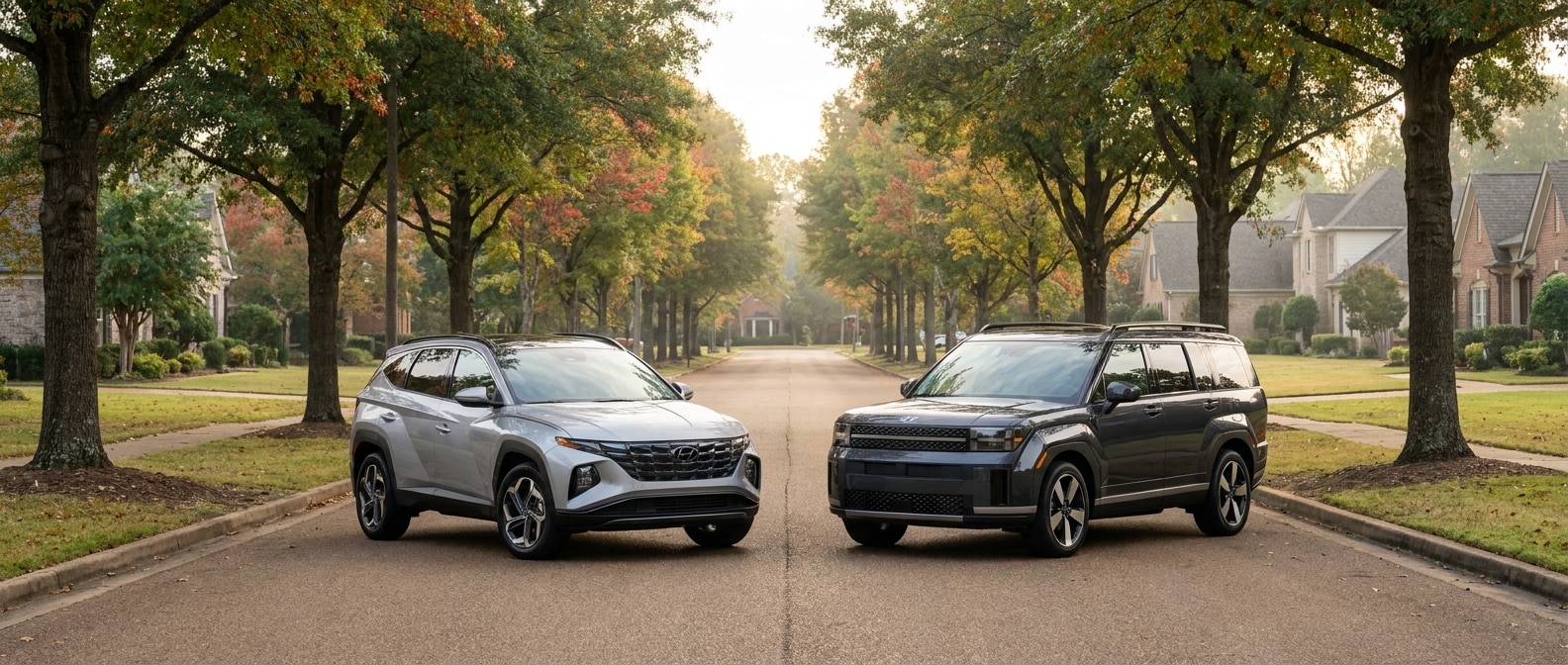
Shopping both of these at once? You're in good company. Starting with the Hyundai Tucson and talking yourself into the Santa Fe is easy, and so is starting with the Santa Fe and realizing you don't really need three rows. The better question is which one fits the life you're actually living on I-55 this fall.
The short version
- The 2026 Tucson seats five and is the sharper pick for a two-adult or small-family household doing daily I-55 commuting, especially in Hybrid form.
- The 2026 Santa Fe seats six or seven across three rows and carries a more powerful turbo engine (277 hp vs. 187 hp); it's built for growing families who need that occasional third-row seat.
- Fuel economy swings hard: the EPA rates the Tucson Hybrid at up to 38 mpg combined, the gas Santa Fe at 24 mpg combined with FWD.
- The honest tradeoff: the Santa Fe's third row is tighter than it looks in photos and works best for kids, not adults.
- Both carry Hyundai's standard suite of driver-assistance tech. Neither requires AWD in our climate.
What's the Real Difference Between the Tucson and Santa Fe?
The 2026 Tucson is a compact two-row SUV built for five people, while the 2026 Santa Fe is a midsize three-row rig seating six or seven, so the single question of whether you'll ever need that back row settles most of this comparison before you even glance at horsepower or cargo numbers. One answer decides more than 80 percent of what you'll weigh here.
| Feature | 2026 Hyundai Tucson | 2026 Hyundai Santa Fe |
|---|---|---|
| Class | Compact SUV | Midsize SUV |
| Seating | 5 (2 rows) | 6-7 (3 rows) |
| Engine / Horsepower | 2.5L 4-cyl / 187 hp | 2.5L Turbo / 277 hp |
| Cargo (behind row 2) | 41.2 cu ft | 40.5 cu ft |
| Cargo (behind row 3) | N/A | 14.6 cu ft |
| Max cargo (all rows down) | 80.3 cu ft | 79.6 cu ft |
| Gas MPG FWD (EPA est.) | 28 combined | 24 combined |
| Hybrid MPG FWD (EPA est.) | Up to 38 combined | 36 combined |
| Overall length | 182.7 in | 190.2 in |
| Standard towing capacity | 2,000 lbs | 3,500 lbs |
The single deciding factor: if you need a third row even occasionally for kids or carpooling, the Santa Fe earns its premium. If you don't, the Tucson gives you better efficiency and an easier footprint in every parking lot on Highland Colony Parkway.
Which One Is Actually Better for Daily Driving?
For the daily I-55 run from Ridgeland down to Jackson, the Tucson is the easier pick, especially in Hybrid form, because the EPA rates the Tucson Hybrid at up to 38 mpg combined against 24 mpg combined for the gas Santa Fe with FWD. On a 30-mile round-trip commute, that gap adds up in a way you'll feel every time you pass a gas station.
The gas Tucson is no slouch either, rated by the EPA at 28 mpg combined with FWD, 25 in the city and 33 on the highway. The Tucson Hybrid pushes that figure up a good deal, and for anyone driving the same corridor five days a week, you'll watch the fuel savings stack up quickly.
Give the Santa Fe its due on power. The turbocharged 2.5-liter produces 277 horsepower and 311 lb-ft of torque. The Tucson's naturally aspirated 2.5-liter makes 187 hp. Merge onto I-55 from Old Agency Road with a full car and you'll feel every bit of that spread. The Santa Fe moves with authority, and the Tucson stays composed and predictable (never sluggish, just calmer), yet the gap is wide enough to name out loud.
The Santa Fe Hybrid closes the efficiency gap considerably, rated at an EPA-estimated 36 mpg combined with FWD, while keeping three-row seating. We'd point a Ridgeland family toward that version if the budget allows.
Our team's read on the commute math: The Tucson Hybrid at 38 mpg combined and the Santa Fe Hybrid at 36 mpg combined are close enough that the call comes back to one question, whether you'll even use that third row. Which one sips a little less at the pump barely moves the needle.
Cargo Space and the Third-Row Reality
Fold every rear seat flat and these two SUVs land within a cubic foot of each other, the Tucson at 80.3 cubic feet and the Santa Fe at 79.6, which puts their maximum cargo numbers close enough that nobody should pick on that figure alone. On paper it's a dead heat. The gaps open once people climb into the seats.
In the Tucson, cargo space behind two adult-occupied rear seats measures 41.2 cubic feet, which is generous for a compact SUV. Groceries, a stroller, soccer gear, a weekend bag for a run out to the Ross Barnett Reservoir, it'll swallow all of it without drama.
Put the Santa Fe's third row to work and the picture shifts. Behind that back row you're down to 14.6 cubic feet, which is small, good for a few bags and a backpack and little else. Fold the third row flat and you jump to 40.5 cubic feet behind the second row, nearly identical to what the Tucson hands you every day.
The boxy shape does pay off in practice, though. Its squared-off roofline keeps the Santa Fe's 40.5 cubic feet cube-shaped and easy to stack, while the Tucson's sloped rear runs more aerodynamic and a touch less forgiving with a tall box. Neither one is a deal-breaker. Just keep the framing straight. The Santa Fe's cargo flexibility comes from folding rows down, so you're not hauling extra room around all day.
So Which One Should You Actually Pick?
For most north-metro Jackson families, the pick comes down to how often you'll truly need a third row, since needing it even one week a month changes the math, and never needing it makes the Tucson the smarter buy.
Choose the 2026 Tucson if: You're two adults, or a family of four with younger kids, you commute I-55 regularly, and your weekends run toward the Natchez Trace Parkway or a Reservoir trip instead of carpooling a baseball team. The Tucson slips into tighter parking spots, costs less to fuel, and gives you more everyday cargo room than the Santa Fe does with its third row occupied. Go Hybrid if you drive more than 12,000 miles a year. Easy call.
Choose the 2026 Santa Fe if: You've got three kids, you regularly pack grandparents along, or you're in that Madison County carpool rotation where an extra seat is simply non-negotiable. The third row handles kids up to roughly middle-school age with room to spare. The 277-hp engine also makes the Santa Fe a more confident highway hauler when you tow a small boat or a trailer out to the Reservoir. And the Santa Fe in Hybrid form at 36 mpg combined lets you carry seven people without feeling punished at the pump.
The Santa Fe carries one fair caveat worth stating plainly. Its third row isn't adult-comfortable for trips past twenty minutes, which holds true for most three-row SUVs in this size class. Don't expect Palisade rear-seat space inside a midsize footprint.
FAQ
Does the Hyundai Tucson have a third row?
No. The 2026 Tucson is a dedicated two-row compact SUV with seating for five passengers. If you need a third row, the Santa Fe is the Hyundai model that provides it as standard equipment, with seating for six or seven depending on whether you choose captain's chairs or a bench in the second row.
Is the Hyundai Santa Fe Hybrid worth the step up from the gas model?
For most Ridgeland-area buyers who plan to keep the vehicle four or more years, yes. The EPA rates the Santa Fe Hybrid at 36 mpg combined with FWD versus 24 mpg combined for the gas model. That's a significant difference over a long ownership period, and the Santa Fe Hybrid still delivers three-row seating with 231 combined horsepower. The one thing you give up is the XRT's 4,500-lb tow rating; the Hybrid doesn't come in that trim for 2026.
Categories:
Social


